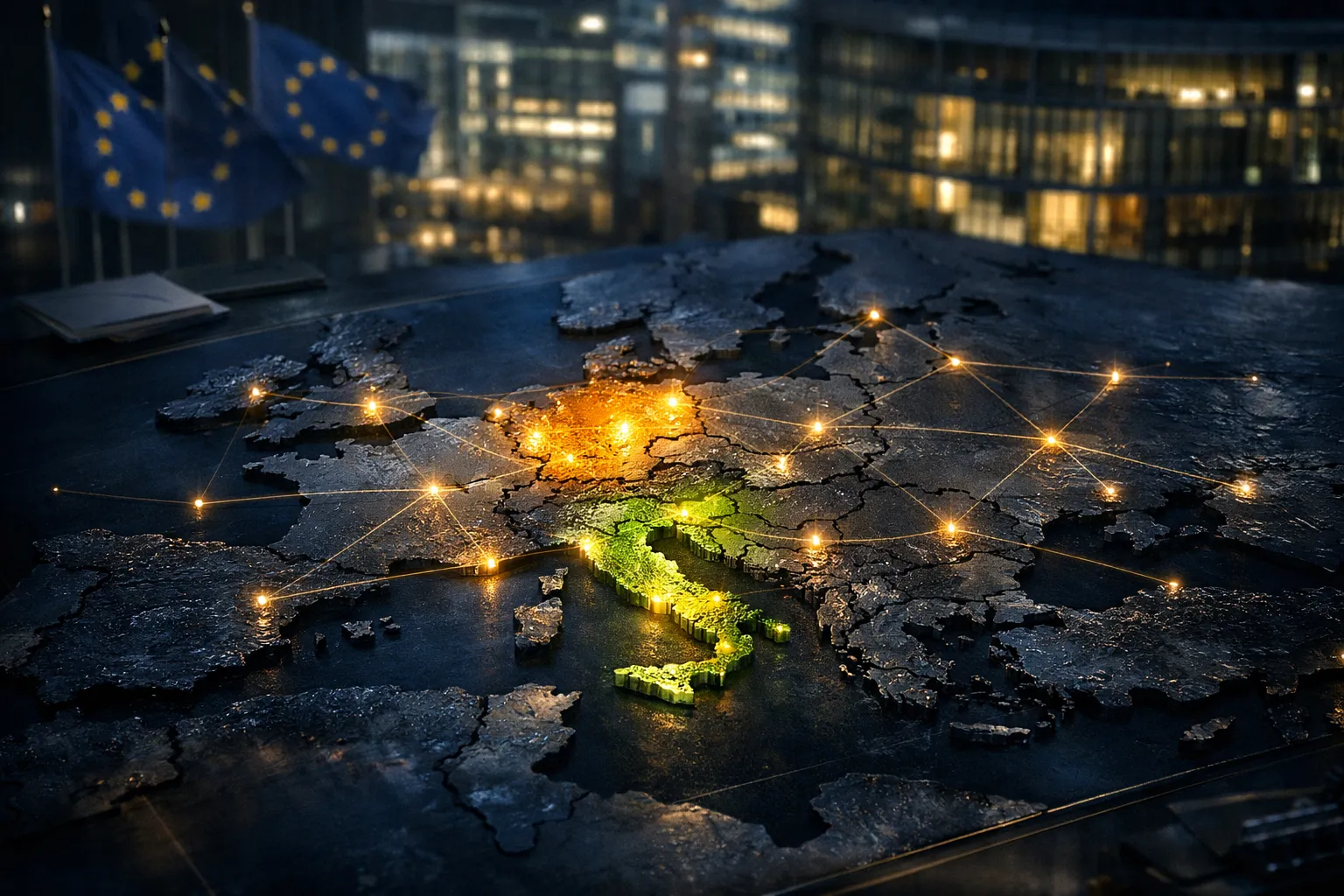
The informal summit of EU heads of state and government on February 12, 2026, at the historic Alden Biesen Castle in Bilzen, eastern Belgium, was mostly about how competitive European businesses are. European Council President António Costa called the retreat a "strategic brainstorming session," but what really happened behind the castle's medieval walls was much more important: a political and existential debate about Europe's economic model, institutional identity, and global position in a world that is becoming more and more influenced by the US and China.
The meeting was the first big chance for the new alliance between Germany and Italy to show how strong it is in Europe. Before the summit, German Chancellor Friedrich Merz and Italian Prime Minister Giorgia Meloni held a preliminary meeting with Belgian Prime Minister Bart De Wever. This meeting set the stage for the larger discussion. What started out as a two-way effort quickly grew: nineteen EU countries, including Austria, Bulgaria, Cyprus, Croatia, Denmark, Finland, France, Greece, Luxembourg, the Netherlands, Poland, the Czech Republic, Romania, Slovakia, Sweden, and Hungary, as well as the European Commission, attended the pre-summit. The leaders talked about three main goals that Italy, Germany, and Belgium put together in a joint guidance document. These were finishing the Single Market, making rules easier to understand and lowering energy prices, and having a trade policy that is both ambitious and realistic.
How "Merzoni" Came to Be
European commentators have called the coming together of Merz and Meloni "Merzoni." This has been happening since late 2025, but it really came together in January 2026. Many people said that the intergovernmental summit that Merz went to in Rome on January 23 was the start of a new Rome-Berlin axis. The two leaders signed a full strategic cooperation package. This included a stronger bilateral Action Plan, a non-binding security and defense framework, and promises to work together more closely in technology and industry. They promised to make NATO's European pillar stronger, make the EU's defense readiness better, and work together to deal with new geopolitical threats.
"Italy and Germany are closer than they've ever been." "Our people and all of Europe will benefit from this," Merz and Meloni said in a joint statement. On January 22, at the World Economic Forum in Davos, Merz said that he and Meloni had come up with "new ideas" for changing the European Union. He called one of these ideas "an emergency brake for the bureaucracy" of the bloc. Their joint policy paper, which they gave to EU partners at Alden Biesen, made it clear that "Continuing on the current path is not an option." "Europe needs to do something now."
At first glance, the two seem like they don't go together. Merz is a conservative Atlanticist and unapologetic economic liberal whose 2008 book "Dare More Capitalism" made it clear that he was in favor of free markets. He says that Germany needs to rebuild its military power, which is a big change from Angela Merkel's years of strategic silence. Meloni, on the other hand, came from Italy's nationalist right. Her party, Fratelli d'Italia, is a descendant of Italian fascism after World War II. But in office, she has shown that she is politically savvy by keeping support for Ukraine and working with the EU while also making herself look like a credible European leader. What brings them together is not ideology, but need. Germany is still the economic engine of Europe, but it needs partners to help the continent become more competitive and better at defense. Italy wants to have power and respect at the center of Europe. Both of them now speak the language of strategic independence.
The German daily Handelsblatt summed it up well: "Italy's prime minister is becoming an increasingly important ally." But some European diplomats say to be careful. Piero Benassi, who used to be Italy's ambassador to Berlin, said, "This is not a strong and structured alliance as the media sometimes makes it out to be." He went on to say that right now, there is mostly "a convergence on specific issues and coinciding short-term interests" instead of a lasting geopolitical bond.
Macron: Here but Less Important
The Merz-Meloni preliminary meeting invited other European leaders, including French President Emmanuel Macron. However, they were mostly there to hear what the Italian-German axis had to say, not to change it. Macron and Merz both came to Alden Biesen, and they both gave a statement to the press. The Chancellor said, "We almost always agree." Meloni, who was standing nearby, also tried to make things better: "We are strengthening our cooperation with Berlin, but this doesn't mean leaving anyone else out."
But the diplomatic geometry tells a different story. Berlin, Paris, and Rome are now in a triangle, but the sides are very different lengths. The connections between Meloni and Merz and between Macron and Merz clearly point to the Chancellor, as if both are trying to win a special relationship with the continent's strongest economy. The Italian prime minister and the French president are connected by the weaker side of the triangle.
There's no doubt that Macron is leaving. His second and last term as president ends in the spring of 2027. Since he called snap parliamentary elections in June 2024, France has been in a state of political turmoil. The gamble went horribly wrong, leaving a hung parliament divided into three irreconcilable groups: the left-wing New Popular Front, Macron's centrist Ensemble alliance, and Marine Le Pen's far-right National Rally. In just over a year, France has had four prime ministers: Michel Barnier, François Bayrou, and Sébastien Lecornu (twice). Bayrou fell in September 2025 after losing a confidence vote 364 to 194. Lecornu's first term lasted less than a day before he was forced to be reappointed. Macron's approval ratings have dropped to about 19%.
European diplomats say bluntly, "Macron is a thing of the past." No matter how hard he tried in his interview with European newspapers to make himself look like the hero of the EU's awakening so that it would no longer be a geopolitical minority at risk of being swept away by the US and China." Macron called for "very concrete decisions by June" at Alden Biesen and asked member states that were willing to work together more. But events have taken over his power. The National Rally is France's most popular party and is in the lead in polls for the 2027 presidential election. An RN government in Paris would change France's views on immigration, Ukraine, and the EU itself in a big way. It would also make Meloni's position in Europe's nationalist right more complicated.
Germany has also not been very interested in Macron's main idea of issuing EU debt together for defense and collective investments. Merz has turned down this idea many times, which shows a structural difference based on two very different economic models. France believes that fiscal capacity and strategic autonomy are two sides of the same coin. This is necessary for funding the defense industry and competing with state-backed investment from the US and China. Germany sees joint borrowing as a way to get to fiscal union, which Berlin won't accept. This disagreement isn't new, but the French champion doesn't have much political power, so it's not as important now.
The "Europe's Superpower" Plan
The plan between Italy and Germany could change how Europe is run. Berlin and Rome say that Europe needs to be able to quickly and logically respond to changes in the geopolitical landscape. They want to make the Union's institutions work better to do this. They want the European Commission to get rid of legislative proposals that "no longer fit with current political goals and stop procedures from moving forward."
In real life, Germany and Italy want European rules to be much simpler. They want to get rid of unnecessary rules so that the biggest economies in the EU can work together more easily to reach their common goals. The joint paper closely follows the findings of two former Italian prime ministers whose reports have become almost canonical texts in Brussels: Mario Draghi's 2024 competitiveness report and Enrico Letta's companion study on the single market. They were both at Alden Biesen. Draghi's report accurately pointed out Europe's structural problems: capital markets that are too fragmented, energy prices that are much higher than those of competitors, and innovation that spreads too slowly. Draghi said at the summit that things had gotten worse since 2024. He called for making it easier to access the single market, getting European savings to work together, boosting European industries, and getting member states that want to work together more. Letta said again that his goal was to finish the single market, especially in services, by 2027.
There was a lot of agreement at the summit on a few things. These included moving toward a "28th regime" that would let EU companies work under the same set of corporate rules across borders, allowing companies to merge in important sectors like telecommunications, and starting a proposed "One Europe, One Market Roadmap and Action Plan" with clear deadlines and goals. Costa said that the Commission should show this plan at the European Council in March. He said that the work "needs to be done in 2026 and 2027.""The proposed Industrial Accelerator Act would boost the manufacturing sector's share of GDP from 14% to 20% by 2035.
But the political questions that Berlin and Rome are raising may never have been more important, especially since Donald Trump came back to the White House with his protectionist and transactional style. Europe is being squeezed from all sides at once: American threats of tariffs, Chinese subsidized exports flooding global markets, and Russia's ongoing military aggression. The EU's economy is also not growing. In the last three months of 2025, GDP growth was only 1.3%, and industrial production growth was only 1.2% from the previous year.
A Europe with Different Speeds
The EU is more broken up than ever at this point. A multi-speed Europe is no longer just a theory that academics argue about; it is something that the bloc's biggest members are actively working on.
The "E6," an informal group of the six biggest EU economies—Germany, France, Italy, Spain, Poland, and the Netherlands—has been the most important institutional change. On January 28, German Finance Minister Lars Klingbeil and his French counterpart Roland Lescure held a videoconference with their counterparts from the other four countries. This was the official start of a format that people in Brussels had been talking about in secret for months. Klingbeil said, "Now is the time for a Europe of two speeds." The six states together make up about 72% of the EU's total GDP.
The E6 agenda is clear and ambitious. It has four main goals: speeding up the capital markets union to give European businesses more access to funding; making the euro a stronger reserve and trade currency around the world; coordinating defense investments to get bigger and cut down on duplication; and getting important raw materials to cut down on reliance on Chinese supply chains. Carlos Cuerpo, the Spanish Economy Minister, said that Trump's threats to annex Greenland were the "epiphany moment" that got the initiative going. He told reporters, "There are no red lines in the discussions within this group."
Critics, especially those from smaller member states, are worried. Ireland and Portugal are worried that the E6 could make Europe a two-tier system where the biggest countries ignore the smaller ones. The finance minister of Portugal told the six to follow the EU's treaties. The idea of a "core Europe" was first brought up by German Christian Democrats Wolfgang Schäuble and Karl Lamers in 1994, and it has been talked about in different ways ever since. But this version has a sharper edge: this is realpolitik Europe, where capability, not ideology, drives decisions.
At the same time, Germany, France, and Poland have brought the Weimar Triangle back to life. This was a three-way diplomatic framework set up in 1991 to improve defense cooperation. The format had been dead for years, but it came back to life in 2025 when Trump cut Europe out of talks with Russia about Ukraine. It has since grown into the larger "Weimar+" group, which includes the UK, Italy, and Spain. It has also held regular ministerial summits to talk about European defense readiness and support for Ukraine. In August 2025, the leaders of the Weimar Triangle met in Chișinău, Moldova. In September, foreign ministers met in Warsaw to talk about NATO's eastern flank.
Bilateral agreements with the United States make political decisions in the EU even harder. Different member states are trying to reach separate agreements with Washington, which weakens the bloc's negotiating power. Merz's planned trip to Washington in March shows that Germany wants to handle its relationship with the US on its own. At the same time, Meloni is using her personal relationship with Trump to her advantage, which sets her apart from most European leaders but also causes problems with Merz. When Merz publicly criticized "MAGA culture" in February, Meloni made it clear that he didn't agree with the criticism. At the African Union Summit in Addis Ababa, he told reporters: "I don't agree with Merz's criticisms of the MAGA culture." These are political evaluations that each leader makes as they see fit. This disagreement over Washington shows a weakness in the supposedly strong partnership between Italy and Germany.
The Battle for Energy
Energy policy is one area where the EU's fragmentation is most clear. The European Council officially voted in January 2026 to end all Russian gas imports by the end of 2027 as part of the REPowerEU plan. The staggered timeline says that short-term LNG contracts can't start until April 2026, long-term LNG contracts can't start until January 2027, and pipeline gas can't start until September to November 2027. There were 24 votes in favor of the law, but Hungary and Slovakia voted against it, and Bulgaria did not vote.
The opposition from Budapest and Bratislava is not merely symbolic. Hungary was still the EU's biggest buyer of Russian fossil fuels in September 2025, spending €166 million a month on oil and €226 million a month on gas. The second biggest buyer was Slovakia. The TurkStream pipeline still brings Russian gas to both countries. In the first nine months of 2025, deliveries through the pipeline were up 7% from the same time last year. Hungarian Foreign Minister Péter Szijjártó has denounced the REPowerEU plan as a "legal trick" that violates national sovereignty over energy policy, and both countries have announced they will challenge the decision before the European Court of Justice. Hungary's state energy company MOL is even building a new pipeline to make it easier for Russian oil to get into Serbia, which is next door. The pipeline is supposed to be finished by 2027.
At least in the short term, the economics support the holdouts' case. Russian pipeline gas is still much cheaper than other options, especially American LNG, which now makes up about 45% of EU LNG imports, up from much lower levels before 2022. The global market should get better in 2026 when new LNG capacity comes online from the US, Qatar, and other suppliers. However, European energy costs are still much higher than those in the US, which makes it hard for European businesses to compete. The EU's overall dependence on Russian gas has dropped from 45% before the invasion to about 12%. However, the last part of diversification will be the most politically sensitive.
The Game in Europe Starts
It looks like everyone in the EU has their own plan for the future of the bloc, and the new situation is one of competing visions rather than a shared agreement. The Italian-German axis has one way to go: practical deregulation, industrial consolidation, and a willingness to move forward with coalitions of the willing instead of waiting for all 27 members to agree. Another option is Macron's France, which has a "Buy European" industrial policy, deeper fiscal integration, and joint borrowing for strategic investments. However, this is coming from a place of growing weakness at home. The E6 is another vector that tries to speed up changes to the financial markets and improve defense coordination among the bloc's biggest economies. And on the outside, countries like Hungary and Slovakia make their own deals with each other, ignoring what the bigger group says about energy, sanctions, and Ukraine.
The stakes are much higher than just money. The defense aspect is now inextricably linked to the competitiveness discourse. Germany's 2026 budget gives the Bundeswehr €82.69 billion, plus €25.5 billion from a special defense fund. This is part of Merz's plan to make Germany "the strongest conventional army in Europe." Berlin is saying that it is willing to spend up to 5% of its GDP on defense. This is a big change for a country that has relied on American security guarantees for decades while ignoring its own military. Berlin has said it might leave the Franco-German-Spanish FCAS fighter jet project to join the rival GCAP program led by Italy, the United Kingdom, and Japan. This would strengthen the Merz-Meloni partnership and weaken Franco-German defense ties at the same time.
Costa said at the end of the Alden Biesen retreat, "In 2026, Europe will deliver." We did it last year on defense, and we'll do it this year on competitiveness. It is still unclear if this hope will be proven right or if it will just be another example of Europe's long history of incrementalism. It's clear that the old Franco-German engine no longer drives the Union without any problems. The strengthening of the Italian-German axis, the officialization of the E6, the revival of the Weimar Triangle, and the ongoing resistance of member states to giving up their sovereign rights all point to a European political landscape that is more divided, more competitive, and possibly more dynamic. The European game is now in full swing, and the rules are being changed as it goes on.