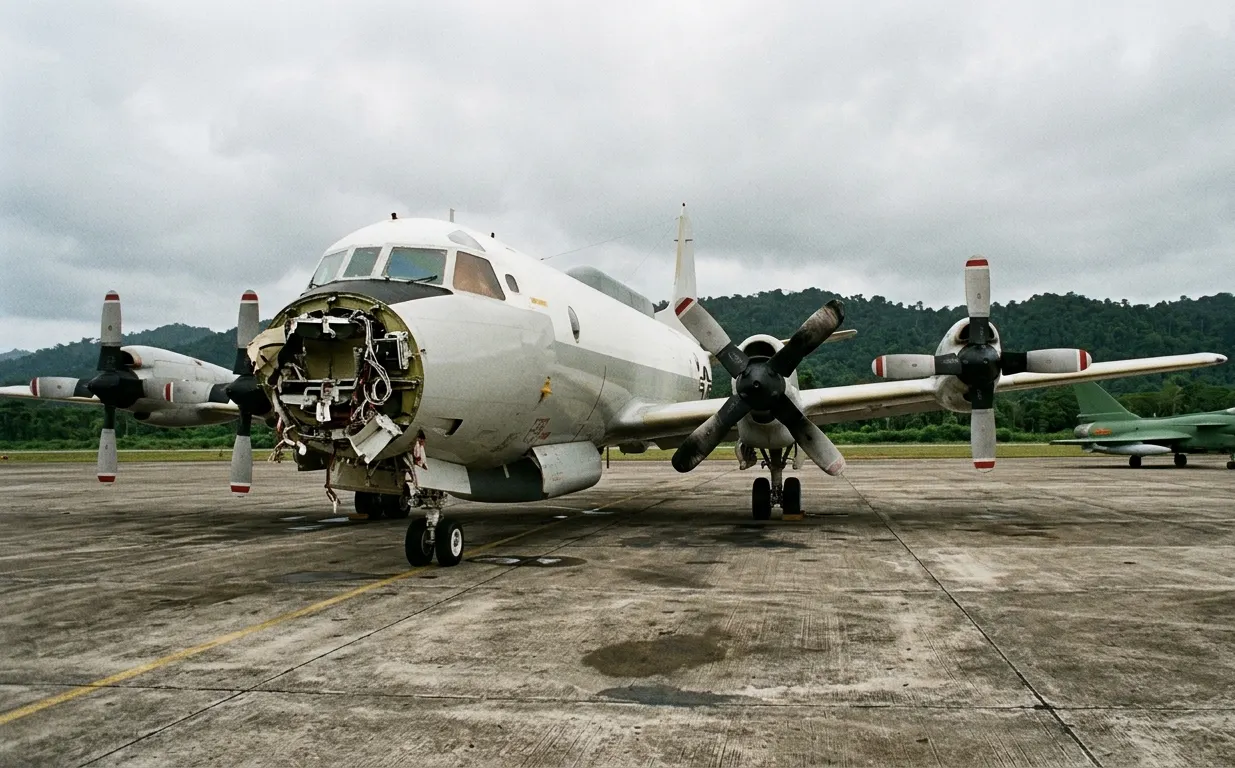
Big crises rarely arrive on schedule. They do not wait for strategy documents to be finished or for statesmen to rehearse their lines. They show up, instead, in the form of two young pilots flying too close to one another over an ocean that neither country fully owns, on a morning that neither capital expected to remember.
The morning was April 1, 2001. Just after 9 a.m. local time, a United States Navy EP-3E ARIES II reconnaissance aircraft was cruising at 22,500 feet, about 70 nautical miles off China's Hainan Island, heading roughly southeast at 180 knots. The EP-3 was on autopilot, five hours into a routine signals intelligence mission out of Kadena Air Base in Okinawa. Its call sign for that flight was PR32. On board were twenty four Americans, twenty one men and three women, drawn from Fleet Air Reconnaissance Squadron One, the VQ-1 "World Watchers," and a Naval Security Group detachment.
Two Chinese J-8II interceptors rose from Lingshui airfield on Hainan to shadow the American plane. The lead pilot was Lieutenant Commander Wang Wei, 33, a naval aviator with a reputation for aggressive intercepts. His wingman was Zhao Yu. In the months before that morning, Wang had been in the cockpit of Chinese jets that buzzed American reconnaissance aircraft in the area repeatedly. On one prior encounter, he had flown close enough to hold up a handwritten note with his email address against the glass, visible to the American crew. The Pentagon had formally protested his behavior. It changed nothing.
On that April morning, Wang flew two close passes at the EP-3. On the third, he came in too fast. The slower, larger American aircraft could not move out of the way. The J-8's tail fin sliced into the EP-3's left aileron and outboard propeller. The Chinese fighter broke apart. The American plane's nose cone was shorn away, one of its four engines was wrecked, and within seconds it was in an almost inverted dive, rolled to 130 degrees and falling 8,000 feet in thirty seconds.
Twenty six minutes
Lieutenant Shane Osborn, the EP-3's aircraft commander, was 26 years old. He had just spent a routine morning, in his words, "guarding the autopilot." Now he was trying to save a 60-ton aircraft pointed almost straight at the South China Sea. In a later interview he recalled looking up through what had been the cockpit window and "seeing water." The plane fell another 6,000 feet before he got the wings level and the nose up, using emergency power on the two remaining engines.
He told the crew to prepare to bail out. Then he changed his mind. Osborn turned the crippled aircraft toward Lingshui, the closest runway and, unhappily, the same base that had launched the fighter that had just killed itself against his wing. Vietnam was around 180 miles the other way, but he had lost most of his flight instruments, the airspeed indicator, and the altimeter, and he doubted the plane would hold together that long.
For the next 26 minutes the 24 people inside that airplane did two things at once. They flew a severely damaged four engined turboprop with no nose, no flaps, no trim, a damaged elevator, one engine disabled, and a propeller that could not be feathered. And they tried to destroy the interior of their own airplane.
That second job went badly. Only one member of the crew had ever taken part in an in flight emergency destruction drill. The standing emergency plan told them to shred or jettison sensitive documents and to destroy equipment with an axe. It did not explain how. Someone poured freshly brewed coffee into motherboards and disk drives. Someone else hacked at hard drives with the survival kit axe, which turned out to be too blunt to do real damage. People smashed computer screens and ripped wires out of panels. Cassette tapes holding intercepted signals were unspooled by hand. Documents were torn up and thrown out of an emergency hatch while the aircraft was still over water. Some of them blew back over land.
By the time Osborn set the plane down at Lingshui at 170 knots with full right aileron and no functioning brakes except the ones on his feet, the cabin, one crew member told investigators, looked like the aftermath of a frat party. At least fifteen distress signals had gone out on international emergency frequencies. None had been answered. The Chinese never responded because the Americans had no agreement with Beijing about what radio frequency to use in such a case, the way they did with Moscow. The base heard the plane only when it saw it.
Military trucks met the aircraft on the runway. Two dozen Chinese soldiers surrounded it. Osborn kept the engines running long enough for the crew to transmit one final message confirming they were on the ground alive. Then the trucks took them away.
The Navy and NSA investigators who would later reconstruct the destruction efforts in forensic detail concluded that despite the crew's improvisation, it was "highly probable" the Chinese recovered classified material. Sixteen cryptographic keys were still intact. So were codebooks; a laptop with signals analysis software called MARTES, and a portable player holding 45 minutes of intercepted Chinese Navy communications, some in the clear. A Radio Signals Notation manual, essentially a guide to how the NSA classifies and exploits foreign signals, was not successfully destroyed. Names of NSA personnel were also compromised.
The long weekend in Beijing
Ambassador Joseph Prueher got the call from the embassy in Beijing around breakfast time on Sunday. A retired four star admiral who had commanded US forces in the Pacific before taking the ambassadorship in late 1999, Prueher was not a China specialist. He was an A-6 Intruder pilot who had flown combat missions over Vietnam. What he understood was military judgment and the personalities of the other retired flag officers now in senior roles in Washington, including Secretary of State Colin Powell and Deputy Secretary Richard Armitage.
Prueher tried to reach someone at the Chinese Foreign Ministry. Nobody answered. It was Sunday morning in Beijing, and it was also Arbor Day. Much of the senior Chinese leadership, including President Jiang Zemin, was out planting trees. There was no functioning equivalent of the twenty four hour Operations Center the State Department ran in Washington. Assistant Foreign Minister Zhou Wenzhong finally received Prueher and political counselor Jim Moriarty at seven that evening, roughly twelve hours after the collision. By then Chinese state media was already broadcasting its version of events: the American plane had rammed the Chinese fighter.
For the next several days, the two sides talked past each other with escalating public stakes.
Beijing demanded a formal apology, payment, an admission of responsibility, and an end to close American reconnaissance along its coast. Chinese officials held back access to the crew, who were kept in military officer housing at Lingshui and interrogated repeatedly. Defense attaché Brigadier General Neal Sealock was not allowed to see them until the early hours of April 4, nearly 63 hours after they had landed. By April 4 and 5, embassy officials in Beijing were quietly worrying that the situation was drifting toward a hostage crisis.
Washington refused to apologize. President Bush said, "I regret that a Chinese pilot is missing, and I regret one of their airplanes is lost." Powell told reporters, "We have nothing to apologize for." Inside the administration, a sharp line had opened between Powell and National Security Adviser Condoleezza Rice, who wanted a negotiated exit, and Defense Secretary Donald Rumsfeld and Vice President Dick Cheney, who viewed any concession as capitulation. The accommodationists won, quietly, because Powell kept negotiations inside a small circle and let Prueher handle the line by line drafting on the ground in Beijing.
The Chinese public campaign intensified. Xinhua published a letter from Wang Wei's widow, Ruan Guoqin, addressed to President Bush. "You are too cowardly to voice an 'apology' and have been trying to shirk your responsibility repeatedly and defame my husband groundlessly," she wrote. Elsewhere she added, "Our six year old son has kept asking me when his father will come home. I pray and call out time and again hoping in tears that there will be a miracle." Chinese television showed her grieving in a hospital bed. Newspapers ran images of Bush with his lips pursed and eyes down. In state media the American president was sometimes referred to as "Little Bush." Wang himself was posthumously declared a "Guardian of Territorial Airspace and Waters."
The Americans were not without levers of their own. Bush's first major Taiwan arms package was due to be decided within weeks. It would eventually, on April 24, include four Kidd class destroyers, diesel submarines, and twelve P-3C anti submarine aircraft, a pointedly ironic choice given that the EP-3E is itself a derivative of the P-3. Before the collision, Bush had already refused to give visiting Vice Premier Qian Qichen assurances that the United States would hold back. After the collision, in an ABC interview on April 25, Bush said he would do "whatever it took" to help Taiwan defend itself.
Two sorries
What broke the stalemate was a letter. Prueher drafted it in English and negotiated it clause by clause with Zhou Wenzhong, often breaking for calls to Powell or Armitage in Washington and returning to the Foreign Ministry within 75 minutes. Powell deliberately kept the Pentagon and the Vice President's office out of the drafting process. The final version carried Prueher's signature alone. Powell later said it spared the President and himself from personally signing any words of regret; he joked, not quite joking, that he had told Prueher, "let's say that it's not the president, it's not me, it's that stupid ambassador that did that."
The phrasing that did the work was what Powell and his team came to call the letter of the two sorries. The United States said it was "very sorry" for the loss of the Chinese pilot and "very sorry" that the American aircraft had entered Chinese airspace and landed without verbal clearance. It did not apologize for the collision. It did not accept fault. In the Chinese translation, the English "sincere regret" from Bush and Powell was rendered as yihan, a word that carries no implication of guilt. The "very sorry" phrases became "qian yi," which also carries no confession of culpability.
Both governments then told their own publics that they had won. American officials pointed out that the United States had never said "apology." Chinese state television told viewers the "hegemonists" had expressed "daoqian," a word that does mean "apology." The ambiguity was not a bug. It was the entire point.
On April 11, the 24 crew members boarded a chartered Continental Airlines flight out of Haikou, routed through Guam and Hawaii, and back to Naval Air Station Whidbey Island in Washington State. The homecoming was called Operation Valiant Return. Osborn received the Distinguished Flying Cross. Bush sent a personal letter of condolence to Ruan Guoqin. The damaged EP-3, serial number 156511, sat on the runway at Lingshui for another three months. China refused to let the Americans fly it home, so Lockheed Martin engineers dismantled it piece by piece. On July 3, it left Hainan in the cargo holds of two Russian operated Antonov An-124 transports and returned to a Lockheed plant in Marietta, Georgia. China billed the United States $34,567.89 for eleven days of room and board for the twenty four crew members. It was paid.
The prologue nobody read at the time
In hindsight, the eleven days look less like an accident and more like the opening scene of a movie that is still running.
Bush had campaigned against Bill Clinton's "strategic partnership" language and promised to treat China as a "strategic competitor." The new administration arrived in January 2001 with that framing already in place and with a China policy split between realists who wanted commerce and realists who wanted containment. The Hainan incident, dropped into their laps in week eleven, was the first real test of which instinct would prevail. Powell's patient wording exercise looked at the time like a small win for the engagement camp. It also obscured the longer term direction of travel.
On the Chinese side, the lesson taken was not that close intercepts were dangerous, though the People's Liberation Army Navy did briefly ease off American surveillance flights after April 2001. The lesson was that the PLA needed better aircraft, better radars, better submarines, and a navy that could push American reconnaissance further from its coast. Defense analysts studying China's military modernization pathway often mark the Hainan incident as one of the accelerants. The three major American close encounters that followed tell the same story in miniature. In March 2009, Chinese ships and aircraft harassed the USNS Impeccable 75 miles south of Hainan. In August 2014, a Chinese J-11BH flew within 30 feet of a US P-8 Poseidon and did a barrel roll over it. In May 2016, two more J-11BHs came within 50 feet of another EP-3 east of Hainan. None of these produced a crisis. All of them could have.
And the airplane itself? The Navy retired EP-3E serial 156511 from active service. In October 2024, it was towed from the Air Force's boneyard in Arizona to the Pima Air and Space Museum in Tucson for restoration and display.
Wang Wei's body was never found.
What I keep coming back to, reading the declassified after action reports and the oral histories, is not the diplomacy. The diplomacy was competent. Prueher, Powell, and Armitage did their jobs. The Chinese Foreign Ministry, once it woke up, did its job too. What unsettles me is the twenty minute window over open ocean. A 33 year old Chinese pilot trying to show off one more time. A 26-year-old American pilot flying straight and level because the autopilot was on. An institution on each side that had not worked out, at the operational level, how to keep its own young men from killing each other. Twenty five years later those institutions have still not worked it out. Chinese fighters still buzz American reconnaissance aircraft. American reconnaissance aircraft still fly the same patterns. The rules have not been written. They almost never are until after someone dies.
Ruan Guoqin's letter asked a question that nobody in Washington wanted to answer in April 2001. Why are you sending them to spy along China's coast from such a great distance? The honest answer, then and now, is that great powers watch each other up close because that is what great powers do. The dishonest answer is that they do it safely.