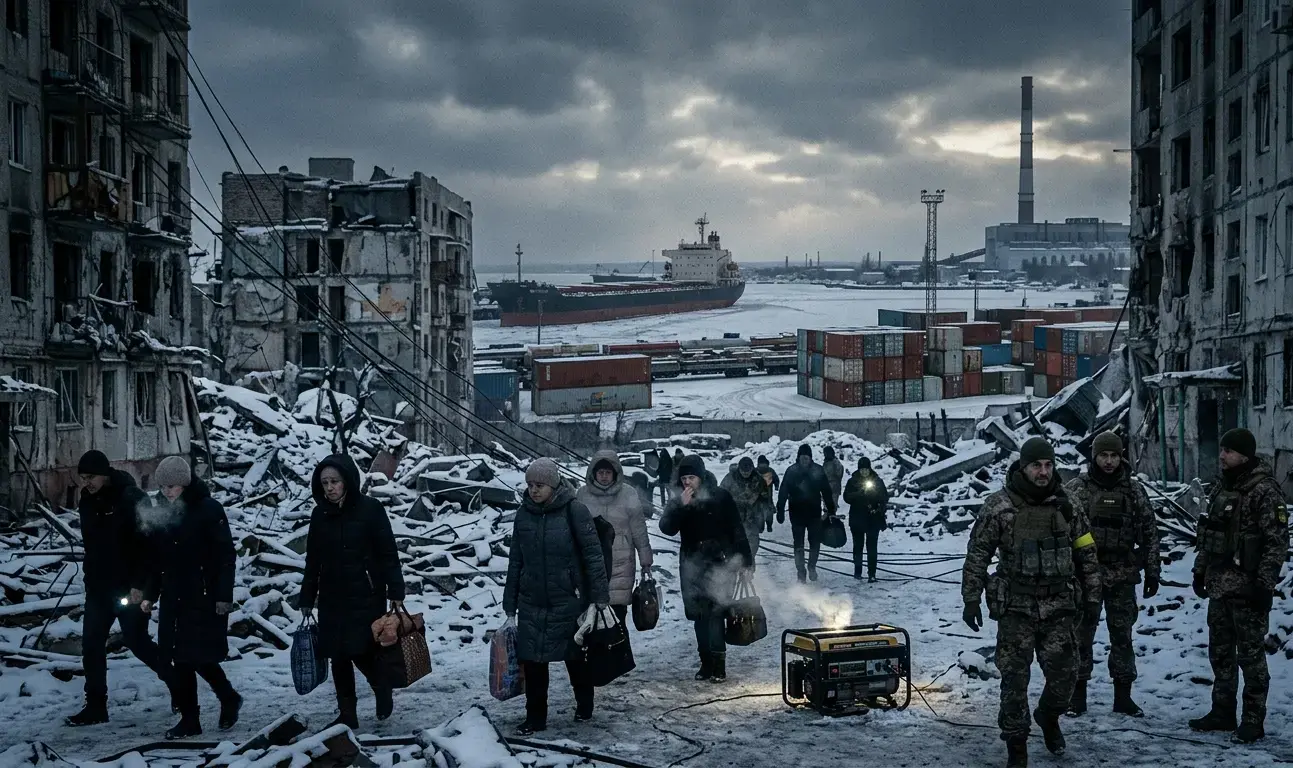
What had been rumored came true on February 24, 2022, proving the analysts right who either had access to the Kremlin or had heard the buzz in Putin's office. When Russian troops invaded Ukraine, a war started that, as of early 2026, has lasted more than 1,400 days with no end in sight. Europe is holding its breath as the strong Ukrainian resistance continues. It is on Ukraine's side and is fighting Russia in a "cold" and commercial war.
But the rest of the world is also very involved. The war between Kyiv and Moscow has caused energy shortages, food shortages, and changes in the way countries interact with each other, from African grain markets to Asian energy corridors.
The front lines are just like the wars of the past: soldiers and civilians die, cities are destroyed, people are tortured, people are left homeless, people are seriously hurt or disabled, and people are living in darkness and cold. But the size is mind-boggling. The Center for Strategic and International Studies (CSIS) did a big study that says that the number of Russian and Ukrainian military deaths could be close to 1.8 million and could reach 2 million by the spring of 2026. According to political scientist Neta Crawford, by the middle of 2025, about 323,000 people will have died, with an average of 7,690 deaths per month. This is more than the average monthly death toll in the Gaza conflict and more than many other wars going on right now.
What makes this war different, though, is what is going on outside of the battlefield. For four years now, while lives are being lost on the front lines, a parallel battle has been going on in diplomatic, business, and government centers, with both Russia and Ukraine trying to hurt each other in other ways. There has never been a war process that involved so many political, diplomatic, and business conflicts at the same time. Putin is trying to get around the embargoes by turning to Asia and using energy bullying against Kyiv and the countries that support it. Zelensky, on the other hand, is looking for more "friendships" and promising future trade deals to get better prices on weapons, big loans, and take advantage of Moscow's frozen reserve treasure.
Economic and diplomatic sanctions are the best ways to put pressure on other countries.
The European Union, the United States, the United Kingdom, Canada, Japan, and other allied countries are the main ones that put economic sanctions on Moscow. These sanctions are what most of the world is putting pressure on Moscow to do.
The EU has made the most sanctions. Brussels had put in place 19 packages of sanctions by the end of 2025, with a 20th package being proposed in February 2026. Each package was more severe and covered more ground. The most important things to do are:
Individual sanctions against more than 2,500 people and organizations, such as senior officials, oligarchs, politicians, state-owned businesses, and military leaders who support or are linked to the war. The net has gotten wider over time: early packages focused on Putin's close friends, but later ones have included military-industrial suppliers, propagandists, and even people who were involved in deporting and brainwashing Ukrainian children, with over 90 such listings by mid-2025.
Restrictions on trade and the economy by banning the import and export of important energy products (mostly Russian oil), technology, and dual-use goods (chemicals, drone parts, microelectronics, and so on). The 19th package in October 2025 notably introduced new export restrictions on artificial intelligence technologies and components used in arms production, recognizing the increasing role of advanced tech in modern warfare.
A price cap was put on Russian oil that is traded internationally by sea when Western shipping or insurance services are used. This was done to keep global oil prices from going through the roof. The cap started at $60 per barrel in December 2022 and was lowered to $47.60 per barrel in the 18th package (July 2025). It also has an automatic dynamic adjustment mechanism that keeps it effective as market conditions change. The goal wasn't to completely stop Russian oil exports, but to limit Russia's income without completely disrupting the global market by only allowing oil to be sold below a certain maximum price. The EU Council says that since the oil price cap and shadow fleet sanctions were put in place, Russian revenues that are important to the EU have dropped by €38 billion. In March 2025, Russian oil revenues were 13.7% lower than in March 2023 and 20.3% lower than in March 2022.
In response, Moscow changed the flows to India and China, which helped lessen the effects but came at a cost. Russian oil is cheaper than the global average, but transportation costs have gone up a lot because it's more complicated to reroute through longer shipping lanes.
Restrictions on financial services include not being able to use international payment systems (like SWIFT), not being able to invest in sectors that are important for national security, and, in a big change, new rules that target cryptocurrency platforms. The 19th sanctions package was the first to put sanctions on a developer of a popular ruble-backed stablecoin (A7A5), its Kyrgyz issuer, and a major trading platform that is linked to it. Russia's Mir payment card system and faster payments system (SBP) were also banned, as were transactions by banks in Belarus and Kazakhstan that use Russia's SPFS messaging system. By the end of 2025, dozens of Russian banks had been banned from doing business with anyone, which was more than just the original SWIFT exclusions.
Energy restrictions: the 19th package put a complete stop to Russian liquefied natural gas (LNG) starting in April 2026 for short-term contracts and January 2027 for longer-term contracts. This is a turning point: Russian LNG shipments kept coming into European ports even as pipeline gas supplies ran out. The EU has also included this in a larger plan to stop importing all Russian natural gas (both pipeline and LNG) by 2028.
There are now a lot more ways to deal with the "shadow fleet." To get around the oil price cap, Russia built a network of old tankers that often flew flags of convenience and had unclear ownership structures. The EU has been tough: by December 2025, 598 ships were subject to EU sanctions, which meant they couldn't enter ports or get maritime services anywhere in Europe. The 17th package alone went after 189 ships in one go. Sanctions now also affect the whole shadow fleet ecosystem, including shipping companies, oil traders, maritime registries, and flag states, in order to stop it from working.
Also, there will be diplomatic sanctions, which means that Russian officials will have limited access to and movement within the EU, and diplomatic relations will be suspended or downgraded. Russian diplomats must now let EU member states know ahead of time when they are going to the Schengen area.
The freezing of the central bank's reserves is the biggest punishment ever
A few days after Russia invaded Ukraine, the EU, the US, the UK, Canada, and Japan made a decision that had never been made before. They froze a big part of the Russian Central Bank's foreign reserves that were held in other countries.
What does this mean in real life? Russia had about $600 billion in reserves, including foreign currency, gold, and bonds, to back up the ruble in case of a crisis, pay for future imports, and keep its banking system stable. About €300 billion of those reserves are now stuck in the EU, other G7 countries, and Australia. About two-thirds of that is in the EU.
The freeze makes it very hard for Moscow to change exchange rates, and the ruble has been unstable many times. To fight the inflationary pressures that came from this, the Central Bank of Russia had to put in place capital controls and raise interest rates by a huge amount, up to 21%, which was the highest among emerging market peers.
This punishment is seen as historic because it's very rare for the central bank of a large economy to be a direct target. It has also started a debate around the world about whether other countries' foreign exchange reserves are really safe when they are held in the West. Some experts say that this example may have pushed other countries, especially China, to speed up the process of diversifying their reserves away from Western currencies and institutions.
The windfall profits that come from reinvesting these frozen Russian assets have become a politically charged issue, in addition to the freeze itself. The G7 decided to send billions of dollars from these frozen assets to Ukraine to help with its defense and rebuilding, which made Moscow even angrier.
Russia has made changes (like putting limits on capital, moving toward Asian markets, and creating alternative payment networks through China's CIPS system and its own SPFS), but this has made its economic policy less flexible and hurt Russia's financial sovereignty as a whole.
Financial Sanctions: Stopping the War Machine
The EU, the US, the UK, Canada, Japan, and other countries have all put in place their own sets of financial sanctions that work together. These include stopping transactions with Russian banks and companies, freezing Russian assets in foreign banks and financial institutions, and keeping banks out of international payment systems.
The US has been especially aggressive in going after Russia's big energy companies. In October 2025, the Trump administration, even though it had been skeptical about sanctions before, worked with the EU and UK to put blocking sanctions on Rosneft and Lukoil, Russia's two biggest oil companies. At the same time, the UK froze the assets of dozens of companies in the Russian energy sector.
Bans on exporting high-value technology like microelectronics, semiconductor manufacturing equipment, precision instruments, machine tools, and software have been meant to stop Russia from being able to keep its military-industrial complex going and modernize it. The EU has steadily added to the list of companies that are not allowed to sell dual-use goods to Russia. One of the most important additions was Chinese companies that sell machine tools and parts to the Russian military sector. This was a big step that could have hurt EU-China relations, but it was necessary because Chinese companies play a big role in keeping Russia's war economy going.
More than 1,500 people and organizations that have been sanctioned have had their assets frozen in Western countries. This includes about €20 billion.
Sports Sanctions: Keeping Russia out of World Sports
Sports is one of the most obvious and psychologically important areas where sanctions have been used to try to cut Russia off from the rest of the sports world.
FIFA and UEFA decided to keep all Russian national teams and clubs out of international competitions, like the World Cup and European Championships, after Russia invaded. This choice had a direct effect on the Russian team's ability to qualify for and compete in major events. FIFA has recently talked about possibly reversing or changing the ban, which has made EU countries and Ukraine's allies very angry.
In the same way, Russian basketball teams have not been allowed to play in Euroleague and FIBA events.
The International Olympic Committee (IOC) is in charge of keeping Russian and Belarusian teams out of the 2024 Paris Games and the 2026 Milan-Cortina Winter Olympics. Only certain athletes can compete as neutrals, but they must never have publicly supported the Russian government or war, even if they are accepted as neutral athletes. Compared to earlier conflicts, this was a big change in the IOC's position.
International sports federations for skiing, skating, track and field, and almost all team sports have done the same thing: they have banned Russian teams from using national symbols at major world events. The end result is that Russia is almost completely left out of the international sports calendar, which is something that has never happened to a major country before.
These bans have two effects: they take away Russia's chance to show off its national pride and soft power, and they make Russian athletes and fans unhappy, which adds to the overall cost of the war in terms of social costs.
The Effects of War: A Global Accounting
The war between Russia and Ukraine is not just a fight between two countries with few effects. It has become a conflict with deep geopolitical, economic, and social effects that affect Europe and the world's major powers. Its effects have been felt in the energy markets, food prices, refugee flows, defense spending, alliance structures, and even the way the post-Cold War world is set up.
Ukraine: Destruction and Strength
The most immediate and terrible effects have been felt by Ukraine.
The cost to people is huge. CSIS estimates that between February 2022 and December 2025, Ukrainian forces probably had between 500,000 and 600,000 casualties (killed, wounded, and missing), with between 100,000 and 140,000 of those being deaths. In February 2025, President Zelensky said that more than 46,000 Ukrainian soldiers had died and 380,000 had been hurt. However, independent estimates say that the real number is higher. The UN's OHCHR said that as of December 2025, there were more than 55,600 verified civilian deaths, including almost 15,000 killed. However, it is known that the actual numbers are much higher.
The crisis of displacement is the biggest in Europe since World War II. The UNHCR says that as of early 2025, there were about 6.9 million Ukrainian refugees around the world, with 6.3 million of them in Europe. Another 3.7 million people are still living in Ukraine but are not in their own homes. According to the UN, 12.7 million people in Ukraine need help with basic needs. There are 2.4 million fewer children in Ukraine now than there were before the war. This is because people have moved away and birth rates have gone down.
The damage to the economy has been terrible. The World Bank's fifth Rapid Damage and Needs Assessment (RDNA5), which came out in February 2026, says that Ukraine will need $587.7 billion over the next ten years to recover and rebuild. This is almost three times the country's projected nominal GDP for 2025. The total amount of direct damage is $195.1 billion, with the housing, transportation, and energy sectors being the hardest hit. In real terms, Ukraine's GDP is still 21% smaller than it was in 2021. More than 2.6 million homes have been damaged or destroyed, more than 2,100 health facilities have been damaged, and about 2,000 schools have been damaged, with 371 of them completely destroyed.
The energy infrastructure has been hit the hardest. Russia's repeated attacks on power plants, substations, and grid infrastructure have pushed Ukraine's power grid to the limit. These attacks got worse in 2024 and 2025. People who live in the east and in Kyiv have gone without power for up to 16 hours a day. Since the invasion, Ukraine's total use of electricity has gone down by about 30%.
But the war has also made Ukraine's national identity stronger and sped up its progress toward joining the European Union. The West sees the country as a symbol of resistance, and its people have shown incredible strength and ability to adapt under unimaginable stress.
Russia: The Cost of Being Aggressive
Russia hasn't had destruction on its own land on the same scale, but it is facing big and growing problems.
The number of soldiers who died is huge and has never happened before in history. CSIS says that between February 2022 and December 2025, Russia lost almost 1.2 million soldiers on the battlefield (killed, wounded, and missing). In 2025 alone, there were about 415,000 deaths, making it the second-deadliest year of the war. The UK Ministry of Defense said in October 2025 that the number was 1,118,000. Mediazona, an independent Russian news site, has confirmed by name that more than 160,000 Russian soldiers have died. These deaths are more than any other major power has suffered in a war since World War II. They are more than 17 times the number of Soviet deaths in Afghanistan, 11 times the number of deaths in both Chechen Wars, and five times the number of deaths in all Russian and Soviet wars since 1945.
In its biggest offensives, Russia has only moved forward by 15 to 70 meters per day on average. This is slower than almost any major offensive campaign in the last century, including the infamous Battle of the Somme in World War I, which was very bloody. By the end of 2025, Russian troops had taken over about 116,000 square kilometers of Ukrainian land, or about 19.2% of the country. Since the beginning of 2024, they had taken less than 1.5% of Ukrainian land. Historically, the cost-benefit ratio of territorial gains versus human losses has been very high.
The economic impact, while not as obvious as the damage done on the battlefield, is very important. Even though people thought the Russian economy would quickly fall apart, it actually stayed strong in 2023–2024, growing at more than 4% per year. This was mostly because of huge military spending (military Keynesianism), more corporate credit, and higher commodity prices. But this growth was not able to last in the long run.
The bill was due by 2025. GDP growth slowed to about 0.6–1.1%. Some analysts say the economy may already be in a recession when you take into account the high cost of military production and the low inflation rate. The PeaceRep research group thinks that real inflation may be about twice as high as the official numbers, which would make reported GDP growth look much worse. Manufacturing is going down, and the Purchasing Managers' Index barely stayed in the growth zone for most of 2025.
Interest rates at 21%, needed to fight double-digit inflation, have hurt the civilian economy, but the military-industrial sector, which gets government subsidies and special treatment, is mostly safe. Russia has two economies: one for war and one for everything else. Companies make more money by putting money in banks that pay 20% interest than by investing in growth. Household lending has almost come to a stop, and the housing market has also stopped.
The National Wealth Fund of Russia, which used to be a strong financial buffer, is running out of money quickly. Its liquid assets fell from a high of $113.5 billion before the war to about $36 billion by the middle of 2025. Some Russian economists say it could run out by 2026. The federal budget deficit from January to July 2025 was about 4.9 trillion rubles (2.2% of GDP). In July 2025, oil tax revenues fell 34% from the same month the year before, the lowest level since January 2023.
Since the invasion, Russia's money supply (M2) has grown from 62 trillion rubles in December 2021 to 118 trillion rubles by February 2025. This is the biggest increase in the money supply in 25 years, according to the Central Bank's own director of monetary policy. This almost guarantees that inflation will keep going up.
The demographic and social costs are significant in addition to macroeconomics. Russia's poorer areas have been hit harder by military deaths than other areas. Since the invasion, about 800,000 educated young Russians have moved to other countries for political or economic reasons. Russia has become more authoritarian even by its own post-Soviet standards, and restrictions on civil liberties, press freedom, and political opposition have gotten much worse. Russia is becoming more isolated from the West, and its growing reliance on China, its main trading partner and technology supplier, has made it more vulnerable in a new way: it is now dependent on China instead of the West, but on much worse terms.
The future doesn't look good in the long run. Russia doesn't have any technology companies that are competitive on a global scale, has a serious labor shortage (unemployment is only 2%, which is very low for an emerging market), and is falling behind in important technologies like AI. Some analysts say that the total cost of Putin's war, including lost GDP, depleted reserves, military spending, capital flight, frozen assets, and loss of human capital, is more than several trillion dollars.
Belarus: More Dependence and Isolation
Belarus is an important ally of Russia because it let Russian troops use its land at the start of the invasion. This has led to more Western sanctions and more isolation from the rest of the world. The EU's 19th sanctions package added more restrictions that were specifically aimed at Belarus. These included freezing the assets of people and businesses involved in the Belarusian military-industrial complex and sectoral sanctions that were similar to those imposed on Russia. Alexander Lukashenko's government is more dependent on Moscow than ever before, in terms of politics, the economy, and the military. Its territory is basically a northern base for Russian operations, and its sovereignty is becoming less and less real.
The Change in Europe
Poland has probably been the European country that has been hit the hardest. It has taken in millions of Ukrainian refugees, which has put a lot of stress on the economy and society. Poland has greatly increased its defense spending, which is now one of the highest in NATO as a percentage of GDP. It has also become a key part of Eastern European security and a strong supporter of Ukraine's cause.
Germany is the best example of a country that has had to rethink its basic strategic choices over the past few decades. Cheap Russian natural gas has been important to the German economy for years. Germany had an energy crisis, rising inflation, and industrial pressure after the invasion and the disruption of flows, which was dramatically shown by the sabotage of the Nord Stream pipelines. Berlin made a historic change to its defense policy by announcing a €100 billion special defense fund and promising to spend more than 2% of its GDP on defense. The war also sped up Germany's move to renewable energy and its search for other gas suppliers, which changed its energy security strategy in a big way.
In April 2023, Finland gave up decades of military neutrality and joined NATO. Sweden joined in March 2024. These choices changed the geopolitical balance in the Baltic and Nordic regions in a big way, making NATO's land border with Russia much bigger. Finland saw membership as a necessary way to protect itself from a more aggressive Moscow.
Turkey took a different route. Even though it was a member of NATO, it didn't fully follow the rules for Western sanctions. Instead, Ankara wanted to act as a mediator, especially in the Black Sea Grain Initiative, and at the same time, it increased its trade with Russia. Turkey used its unique geopolitical position to strengthen its independence from both the West and Moscow. It was in a delicate balancing act: it was a strategic partner of Ukraine in some areas (especially by supplying Bayraktar drones), but it was also an economic partner and sometimes a safe haven for Russian capital that had been sanctioned.
Reverberations around the world
The US has given Ukraine tens of billions of dollars in military and economic aid, increased its presence in Europe, and used the war to strengthen the Western alliance. But the war has caused a lot of political division within the country over how much aid should cost. During President Trump's second term, the approach has changed. There has been talk about Europe solving its own problems, but there has also been continued (if sometimes reluctant) coordination of sanctions and, in October 2025, major new energy sanctions.
China hasn't openly criticized Russia and is keeping an eye on what Moscow does with a friendly attitude. Beijing benefits from cheap Russian energy by buying a lot of oil, gas, and coal at prices lower than the market rate. It also benefits from Russia becoming more dependent on Chinese technology, payment systems, and trade routes, which strengthens Beijing's geo-economic power. Beijing also tries to avoid secondary sanctions from the West by carefully positioning itself diplomatically, but the EU's targeting of Chinese companies that supply Russia's military-industrial complex has made things worse. China is using the conflict to strengthen its position as an alternative center of power and test the limits of Western unity. However, it is also careful not to get too close to a war that has been condemned by the world and is becoming more expensive.
India benefited from the change in energy flows by buying a lot of Russian oil at big discounts. This made its energy security stronger and kept inflation in check at home. India also kept close ties with the US and other Western partners while following a policy of strategic autonomy. The war made India look more like an independent power that doesn't pick sides.
Japan took a more clear pro-Western stance by putting sanctions on Russia, raising its defense spending, and working more closely with the United States. The war in Europe made Tokyo more worried about security in Asia, especially Taiwan, and led to Japan's biggest review of its defense policy in decades.
Brazil and other countries in Latin America chose to be neutral or balanced. The main effect there was on the economy, because Russia is a major global supplier of fertilizer and agricultural goods, and prices for these goods went up and down. Several governments tried to stay neutral and keep lines of communication open with both the West and Moscow.
The effects were more immediate and often more painful on a social level in Africa and the Middle East. Russia and Ukraine are two of the biggest exporters of wheat in the world, and many countries depend on them for grain. Stopping or limiting exports caused prices to go up and food to run out, which made economies that were already weak even more unstable. At the same time, higher energy prices helped some Middle Eastern countries that produce oil, making them more money from oil and natural gas and giving them more power in diplomacy as alternative suppliers.
The Long Shadow of War
The war in Ukraine has changed the way the world works in ways that will last for decades, even though it has been going on for almost four years. The sanctions against Russia are the biggest, most comprehensive, and best-coordinated in history. They haven't stopped the war, but they have severely hurt Russia's economy, military-industrial capacity, and standing in the world. Russia is paying a huge price for very small territorial gains, and by most measures, it is quickly losing its status as a major economic power.
Ukraine has paid a terrible price to stay alive, but the country's strength has made it a key player in European security talks and sped up its integration with Western institutions. The reconstruction bill, which is close to $600 billion, will be one of the biggest economic and political problems of the next ten years.
The war has shown the world that the idea that great-power relations would stay stable after the Cold War was wrong, that being dependent on energy is a strategic weakness, and that the international financial system can be used as a weapon in ways that were never thought possible before. The effects, such as changing the population of Europe because of the flow of refugees and speeding up the trend of de-dollarization in Asia, will last long after the last shot is fired.