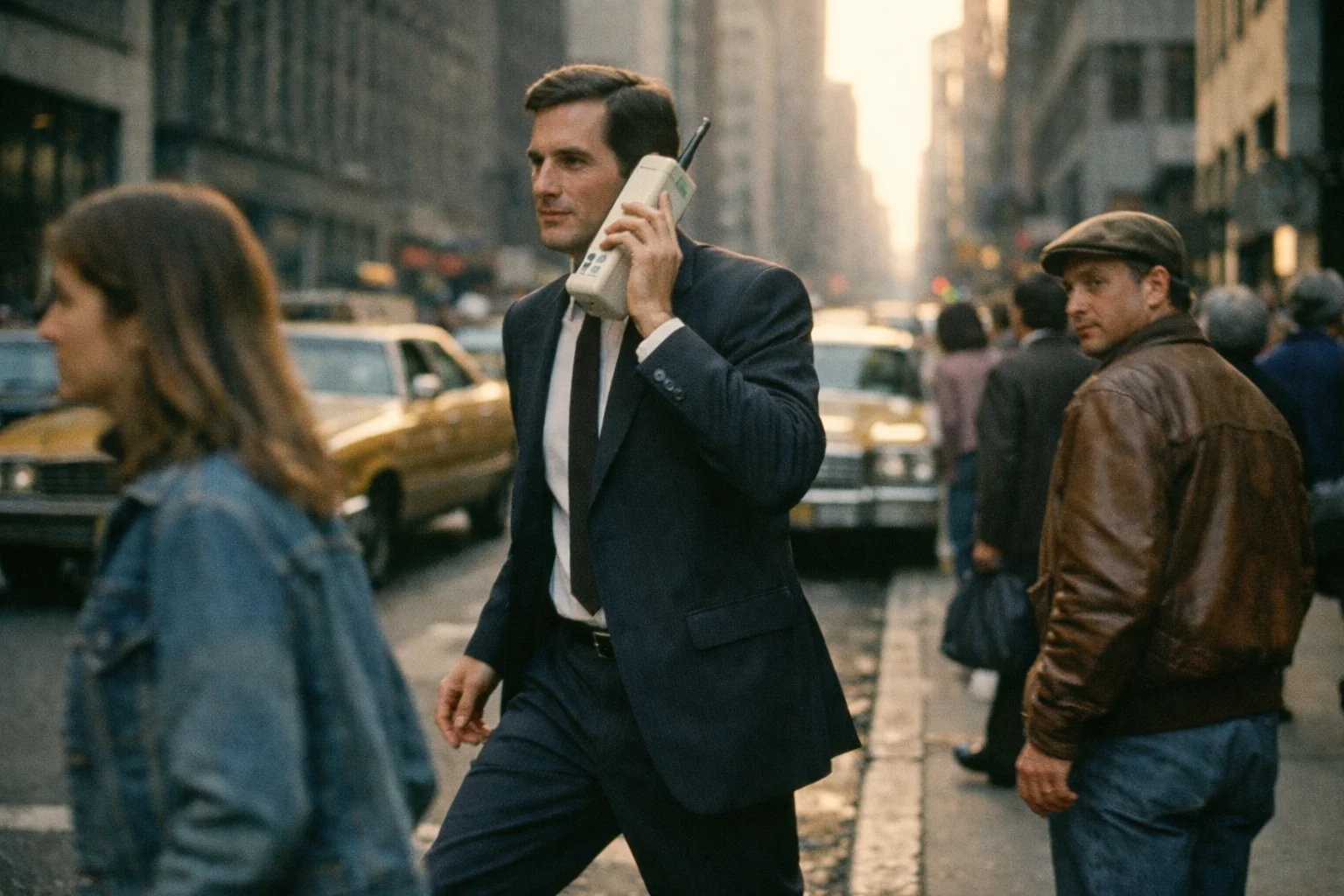
On a Tuesday afternoon in April 1973, a tall engineer in a dark suit stood on a Manhattan sidewalk holding what looked like a cream-colored brick with a rubber antenna sticking out the top. He had walked out of the New York Hilton on Sixth Avenue, past the reporters he had invited to watch, and stepped into the street to place a call. The device in his hand weighed two and a half pounds. Its battery held enough charge for about thirty-five minutes of conversation and needed ten hours to recharge. Nothing about it looked like the future.
The man was Martin Cooper, head of Motorola's communications systems division. The number he dialed belonged to Dr. Joel Engel, the man running AT&T's competing cellular project at Bell Labs in New Jersey. The two had known each other since high school. Engel had reportedly tormented Cooper back then with the nickname "Farty McCooper," and the call Cooper placed on that sidewalk was not purely a technical demonstration. It was a taunt.
"Joel, this is Marty. I'm calling you from a cell phone, but a real cell phone. A personal, handheld, portable cell phone." Engel, according to Cooper's telling, was polite but quiet. He did not want to talk. He had just been beaten in public by a competitor he had not taken seriously, using a concept his own institution had invented.
That awkward silence on the other end of the line was the sound of a seventy-year industrial order beginning to crack.
The system Motorola was built to beat
To understand why Cooper's call mattered, forget what a phone looks like now and picture what it was then. A telephone was a piece of furniture. It had a cord. It lived on a wall or a small table, and it was owned by AT&T. Ma Bell did not sell you the phone. You leased it along with your service, and if you unscrewed the handset cover to look inside, you had technically violated the contract.
AT&T in 1973 was the largest corporation on Earth. Around a million people worked for it. It had roughly seventy-five billion dollars in assets at a time when that was a staggering sum. It owned Western Electric, which made nearly every piece of equipment that touched the American phone network. It owned Bell Labs, one of the most productive scientific institutions in human history, where the transistor, the laser, information theory, and the cosmic microwave background had all been born or discovered. And it owned the wires, the switches, and the long-distance lines that tied the country together. The arrangement was legal. The government had granted AT&T a regulated monopoly in exchange for a promise of universal service.
Bell Labs had actually conceived of cellular radio back in 1947. The idea was elegant: divide a service area into small hexagonal "cells," each with its own low-power base station, and hand calls off between them as a user moved. The capacity problem of early mobile telephony, where one city might have only a dozen usable channels, would vanish. You could serve millions of subscribers instead of hundreds.
But Bell Labs was part of AT&T, and AT&T's vision of mobile telephony was a car phone, the Improved Mobile Telephone Service that had been introduced in 1964. IMTS in the early 1970s had waiting lists up to three years long in major American cities because there simply were not enough channels to go around. Subscribers leased the hardware from the phone company for as much as a hundred and twenty dollars a month. Airtime cost up to a dollar twenty a minute. And the phone was bolted into the trunk of your car, drawing current straight from the battery through thick power cables. It was less a telephone than a radiotelephone attached to a vehicle.
AT&T's cellular plan, the one Engel was running, extended this logic. The phone would still live in the car. The network would still belong to the carrier. Communication would remain a service dispensed from the center outward, on infrastructure the subscriber would never touch and never own.
Motorola was the insurgent. It was a "little company in Chicago," as Cooper later described it, in a market the giant did not think was worth defending. Its leadership, in particular John Mitchell, Cooper's boss and mentor, had concluded that a car-bound cellular system would hand AT&T a monopoly on a new generation of telephony before it had even begun. The only way to stop that was to prove the alternative existed. Motorola invested roughly one hundred million dollars between 1973 and 1993 in cellular development, most of it before the company earned a dollar in cellular revenue. Cooper's team pulled the first prototype together in about ninety days. They had two working units on the day of the press conference, and Cooper admitted later that his biggest fear walking out onto Sixth Avenue was that his would not switch on.
From a brick to a trillion dollars
The handset Cooper used that day was a prototype of what would eventually be sold as the Motorola DynaTAC 8000X. It took ten years and multiple redesigns to bring it to market. The FCC finally approved commercial cellular service in 1983. The production phone went on sale the following year at a price of around four thousand dollars, which is close to twelve thousand today. It still weighed more than two pounds. Its battery still died after about an hour. Gordon Gekko waved one around on a beach in the 1987 film Wall Street, and for most of the decade the DynaTAC was less a communications device than a status symbol for people who wanted you to know they could afford one.
The arithmetic changed faster than anyone predicted. Motorola had told the FCC in 1973 that service might eventually cost ten or twelve dollars a month. That sounded like fantasy at the time. It turned out to be a conservative estimate of where the market was heading. Once the underlying cellular standard was in place, the constraints that had kept the industry small, channel scarcity, hardware cost, and battery weight collapsed one after another. The StarTAC flip phone arrived in 1996. The BlackBerry made email portable in the early 2000s. Nokia at its peak in 2007 sold more phones than anyone had ever sold of anything. And then, later that same year, Apple released the iPhone, and the handset stopped being a phone.
The device in your pocket today is a general-purpose computer with a radio. It is several radios, actually: cellular, Wi-Fi, Bluetooth, NFC, and GPS. It has more processing power than the laptops of a decade ago and more memory than the desktops. It is a camera, a wallet, a boarding pass, a bank branch, a medical sensor, a map, a library, a photograph album, a television, and a grocery store. The industry that grew up around it has no real precedent. Global smartphone hardware sales alone were worth around six hundred billion dollars in 2025, with the market projected to move past one trillion dollars in the early 2030s. Over 1.2 billion handsets shipped in 2024. Roughly five and a half billion people now carry one.
The hardware is the smaller half of the story. A study commissioned by Apple and conducted by economists at Boston University and Analysis Group found that the App Store ecosystem alone facilitated about 1.3 trillion dollars in billings and sales in 2024, a figure that had more than doubled since 2019. Most of that was not digital. Around a trillion dollars' worth was physical: food delivery orders, grocery runs, ride-hail trips, and retail purchases that happened to be placed through a phone. Another 150 billion was in-app advertising. Only 131 billion were digital goods, games, streaming subscriptions, and productivity apps. Apple and Google together collected around 150 billion in direct App Store and Play Store revenue. China alone accounted for 539 billion dollars of the App Store ecosystem's activity, the United States for 406 billion, and Europe for 148 billion.
Those numbers, taken together, describe something that did not exist fifty-three years ago: a consumer device so deeply woven into daily economic life that its absence, for most people, would be closer to losing a limb than losing a gadget. Pew Research found back in 2013 that forty-four percent of American cell phone owners slept with the device next to the bed. That number has only grown.
When the phone became a weapon
Somewhere along the way, around the mid-2010s, governments began to notice that the object in everyone's pocket was no longer a consumer product in any ordinary sense. It was a continuously updated stream of location data, financial transactions, personal communications, and biometric information, routed through networks owned by a small number of companies, running software controlled by an even smaller number of them. Whoever set the standards for the next generation of those networks and whoever supplied the equipment was going to be in a position most military planners would recognize immediately.
The fight over Huawei is the clearest window into what happened next. Huawei, founded in Shenzhen in 1987, had by the late 2010s become one of the largest suppliers of telecommunications equipment in the world, with a particular edge in 5G base stations. It was also, in the view of successive U.S. administrations, an instrument of the Chinese state. The Department of Justice indicted the company and its chief financial officer, Meng Wanzhou, in 2019 on charges including bank fraud, sanctions violations related to Iran, and theft of trade secrets. In May of that year the Commerce Department placed Huawei on the Entity List, the sanctioned-trade registry that requires American firms to obtain a license before selling anything subject to U.S. export controls to a listed entity. By 2020, the restrictions had been extended to any chip anywhere in the world produced using U.S. technology. Washington was, in effect, trying to cut Huawei off from the modern semiconductor industry.
The campaign reshaped the global telecommunications equipment market and did not quite work. The United Kingdom, Australia, Japan, and a long list of European and Asian states followed Washington's lead in restricting Huawei from their 5G networks. Congress appropriated 1.9 billion dollars to strip existing Huawei gear out of American rural carrier networks. Huawei's global smartphone share cratered. It looked for a while as if the company might be dismantled.
It was not. In August 2023, Huawei released the Mate 60 Pro, a phone powered by a 5G-capable chip designed by its HiSilicon subsidiary and manufactured by the Chinese foundry SMIC. Neither company was supposed to be able to produce such a chip at all under the sanctions regime. Huawei sales in China surged; one research firm recorded a sixty-four percent year-on-year jump in smartphone sales during the first six weeks of 2024. The company's domestic telecommunications business, meanwhile, had been untouchable from the start: by 2021 Huawei was supplying around sixty percent of 5G base station contracts for China Mobile, the state-owned carrier. A 2025 analysis from the Information Technology and Innovation Foundation, hardly a pro-Beijing outfit, concluded that the export controls had "backfired," accelerating Chinese semiconductor self-sufficiency and eroding the global market position of American suppliers who had previously sold to Huawei.
The Huawei fight is only the most visible theater. There is the parallel dispute over TikTok, which the United States has alternately threatened to ban and ordered divested from its Chinese parent company. There is the ongoing American effort to prevent advanced lithography equipment from being sold to Chinese chipmakers, which has pulled the Dutch firm ASML into a role it clearly did not want. There is Beijing's retaliatory use of its Anti-Foreign Sanctions Law to threaten any company that complies too enthusiastically with Washington's rules. There is the unresolved question of whether a foldable phone designed in California, assembled in Vietnam, and using Korean memory, Taiwanese processors, and Japanese camera sensors can even be said to belong to a single country anymore.
What is striking is how thoroughly the terms of the argument have moved. In 1973, the question was whether the telephone should be tethered to the network. By 2026, the question is which sovereign power gets to sit at the root of the stack: who controls the silicon, who writes the operating system, who holds the keys to the app store, who sees the location pings, and who decides which handsets can connect to which base stations. The device itself is almost incidental. The device is the terrain the war is fought over.
Cooper, who is ninety-seven and still lives in Del Mar, California, has been asked about this many times. He tends to be cheerful about it. He likes pointing out that a modern smartphone does too many things and does none of them particularly well, that the instruction manual for his Samsung is heavier than the phone itself, and that eventually the device will probably disappear into our ears or our eyes. He is less cheerful about surveillance, about the loss of privacy that came with the thing he spent his career building. But he does not regret the original bet. He wanted to break AT&T's grip on telephony. He did.
Whether the grip he broke has been replaced by something looser or something tighter is an open question. Five companies now control most of the mobile operating system market and virtually all of it in the West. Two of them decide which applications get to run on roughly seven billion pockets. A handful of chip designers supply the processors for all of them. The cellular infrastructure is built by four major vendors globally, two Chinese and two European, and governments fight publicly over which ones are allowed to sell where. The personal, handheld, portable cell phone that Cooper demonstrated on Sixth Avenue arrived as a tool of decentralization. It has matured into one of the most concentrated industries that has ever existed.
On the day he placed the first call, Cooper walked across Sixth Avenue talking to a New York radio reporter. He later said it was probably one of the most dangerous things he had ever done in his life, because he was not watching for traffic. A taxi almost hit him. Fifty-three years later, people walk into fountains and off kerbs and through crosswalks, staring at the descendant of his invention. Cooper, who has seen the figures and knows what his phone started, laughs about it. The rest of us probably should.