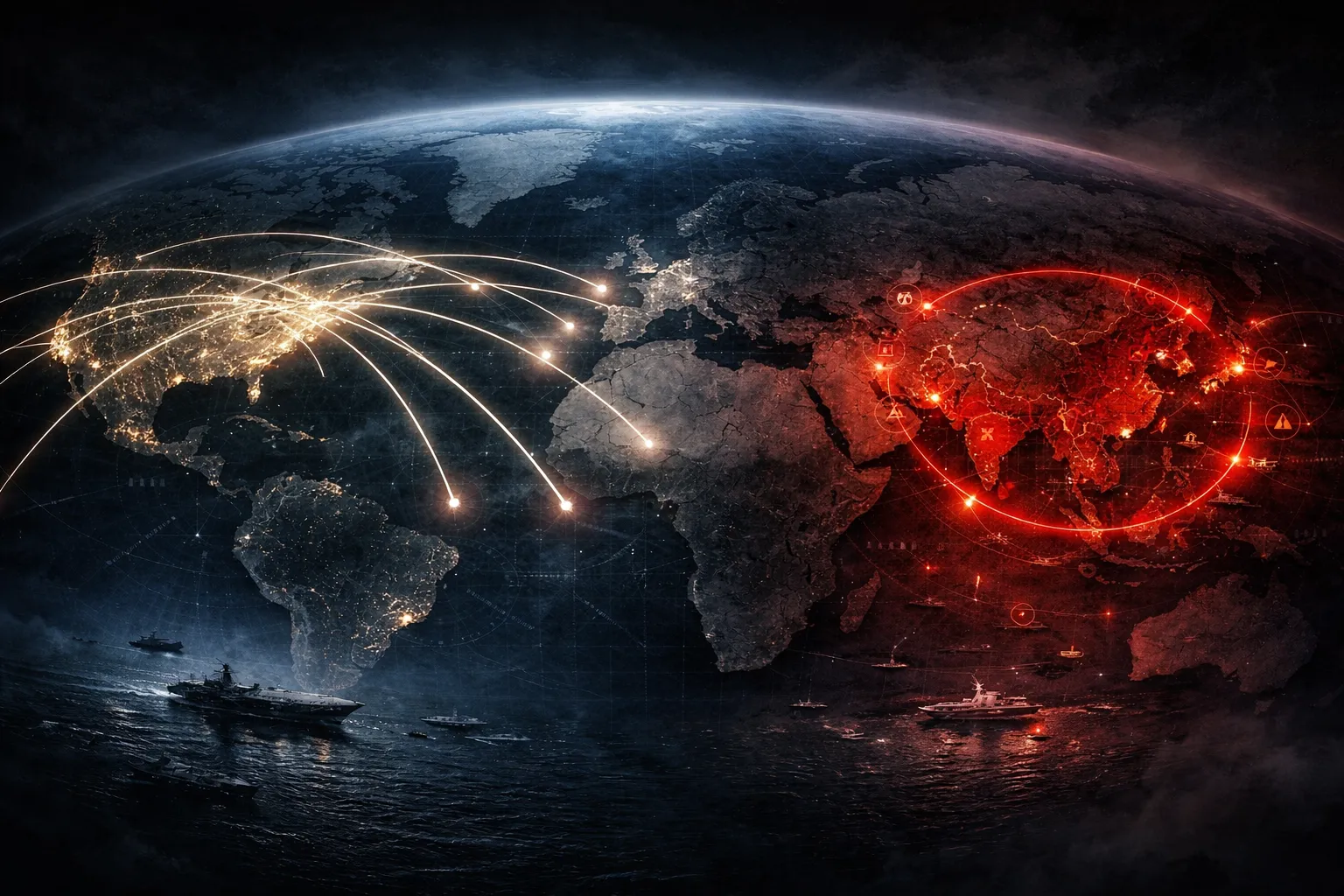
The US and China have become the two most powerful countries in the world since the end of World War II in 1945. Both have nuclear weapons, big economies, and armies that can project power far beyond their borders. But their ways of fighting wars over the past 80 years are very different. The US has been involved in military operations on every continent, from the jungles of Vietnam to the deserts of Iraq, almost without stopping. China, on the other hand, has fought in less than a dozen direct military conflicts, most of which were along its own borders. It hasn't fought a full-scale war since 1979.
This difference isn't just about numbers. It shows that there are very different strategic philosophies, historical experiences, and geopolitical priorities. Anyone who wants to understand the current world order and the growing tensions between Washington and Beijing needs to know about these differences.
The American Model: Long-Term Global Involvement
The Cold War marks the beginning of the story of American military involvement after 1945. The US became the most powerful country in history after World War II, with military bases all over Europe, Asia, and the Pacific. The United States decided to keep and grow its military presence around the world instead of demobilizing like it did after World War I. The goal was containment: stopping the spread of Soviet communism through a mix of alliances, troops stationed in other countries, and, if necessary, direct military action.
Vietnam and Korea: The Important Wars
The Korean War (1950–1953) established the framework for American military involvement during the Cold War. When North Korean troops invaded South Korea in June 1950, the United States led a coalition of UN member states to stop the invasion. The war ended in a stalemate, and the Korean Peninsula was split along the same line as it had been before the fighting started. More than 36,000 Americans died, and the war led to a permanent U.S. military presence in South Korea that is still there today.
Vietnam turned out to be even more important. Under Presidents Kennedy, Johnson, and Nixon, what started as a small advisory mission under President Eisenhower turned into a full-scale war. At its height, the United States sent more than 500,000 troops to Southeast Asia. The war killed more than 58,000 Americans and millions of Vietnamese. The fall of Saigon in 1975 was the biggest military loss in American history and had a lasting effect on the minds of Americans. But even Vietnam didn't change the way the US fights wars around the world. After ten years, the US was back in Grenada, Lebanon, and Central America.
The Post Cold War Era: Interventions Without Competition
The United States was the only superpower after the Soviet Union fell apart in 1991. This unipolar moment did not slow down American military activity; it sped it up. The Persian Gulf War of 1991 showed how much better American conventional forces are than others when a coalition led by the U.S. kicked Iraqi forces out of Kuwait in just a few weeks. This quick and clear win made people feel like the military was unbeatable, which would affect American decisions for the next twenty years.
During the 1990s, the US got involved in Somalia, Haiti, Bosnia, and Kosovo. Some of these operations were meant to help people. Others were meant to make regions that were thought to be strategically important more stable. All of them reinforced the idea that the United States had both the capability and the responsibility to use military force to shape global events.
The War on Terror: Twenty Years of Constant Fighting
The attacks on September 11, 2001, changed American military policy once more. The invasion of Iraq in March 2003 was much more controversial than the invasion of Afghanistan in October 2001. These two wars would use up American military resources for twenty years, cost trillions of dollars, and kill hundreds of thousands of people on all sides.
The war in Afghanistan lasted from 2001 until the chaotic withdrawal in August 2021, making it the longest war in American history. After Saddam Hussein was overthrown, Iraq fell into years of sectarian violence and insurgency. The rise of the Islamic State in 2014 led the United States to start another military campaign in Iraq and Syria, which is still going on in some form today.
In addition to these headline conflicts, the United States has built a huge counterterrorism infrastructure that includes drone strikes in Pakistan, Yemen, and Somalia, special operations forces in dozens of countries in Africa and the Middle East, and a global network of military bases and intelligence outposts that would have been unimaginable to people in the past.
The Present Situation
The United States is still involved in several military operations as of 2025. In Syria and Iraq, operations against ISIS remnants are still going on. Counterterrorism operations are still going on in Somalia and other parts of East Africa. The U.S. Navy has attacked Houthi targets in Yemen. As part of the fight against drug cartels, American troops have been sent to the Caribbean. During the twelve-day Iran-Israel war in June 2025, the United States and Israel worked together to bomb Iranian nuclear sites.
Since 1945, the United States has carried out hundreds of different military operations. No other country in modern history has used military force as often or as far from its own borders as this one.
The Chinese Model: Strategic Restraint at the Edge
Since 1945, China's military history has been very different. The People's Republic of China was founded in 1949 after the Communists won the civil war. The country had been through decades of war and was in ruins. At least two million people died in the civil war from 1945 to 1949. This was after the Second Sino-Japanese War, which killed an estimated 15 million Chinese people.
Even though it started out violently, the PRC has had very few external military conflicts. China has had fewer direct military conflicts than the US, and all of them have happened on or very close to its own borders.
China's first battle: the Korean War
China's involvement in the Korean War in October 1950 changed the new republic in a big way. Mao Zedong made the bad choice to send hundreds of thousands of Chinese "volunteers" across the Yalu River when United Nations troops led by General Douglas MacArthur moved north toward the Chinese border. The fight that came out of it was terrible. There were a lot of deaths among Chinese troops, with estimates ranging from 180,000 to more than 400,000. An American bombing raid killed Mao's own son.
China was willing to pay a lot of human costs to protect what it saw as important security interests on its border during the Korean War. It also set a pattern for how the Chinese military would act for decades: they would only intervene when the security of the homeland itself seemed to be in danger.
Tibet and Taiwan: Strengthening the Borders
Beijing said that the PLA's takeover of Tibet in 1950 and 1951 was a liberation of Chinese land, not a war with another country. The Tibetan army couldn't stand up to the PLA, and there wasn't much formal resistance. However, guerrilla resistance went on for years, and a big uprising broke out in 1959.
During the two Taiwan Strait Crises in 1954–1955 and 1958, Nationalist-held islands were bombarded with heavy artillery, but Taiwan was never fully invaded. These events showed that China was determined to claim sovereignty over what it saw as its own territory, but it was also careful not to start a direct military conflict with the US, which had promised to protect Taiwan.
The Sino-Indian War and the Sino-Soviet Wars
The short Sino-Indian War of 1962 was a fight over the border between India and China in the Himalayas. Chinese troops quickly attacked, pushed Indian troops back on both fronts, and then called a ceasefire and left without anyone else. The whole war only lasted a month. China kept control of Aksai Chin, which it thought was very important to its strategy, but it didn't try to move further into Indian territory.
The fights along the Ussuri River with the Soviet Union in 1969 were even worse. Fighting between Chinese and Soviet troops almost led to a larger war between the two nuclear powers. The crisis was finally settled through diplomacy, but it made it clear that China's military concerns were mostly about its huge and often disputed land borders.
China's Last War: The Sino-Vietnamese War
China's last full-scale military operation was the invasion of northern Vietnam in 1979. The war lasted about a month and was started because Vietnam invaded Cambodia and got closer to the Soviet Union. China sent between 200,000 and 400,000 troops to Cambodia, where they lost a lot of men, with estimates of 25,000 dead. They left without achieving their main goal of forcing Vietnam out of Cambodia.
There was low-level fighting along the Sino-Vietnamese border throughout the 1980s, but the 1979 war was the last time China sent a lot of regular troops into battle. That means China hasn't fought a major war in more than 45 years, which is a long time for a great power to not fight a war.
After 1979, there were fights and standoffs.
China's military actions since 1979 have mostly been small naval battles, standoffs at the border, and peacekeeping missions. The Johnson South Reef Skirmish with Vietnam in the Spratly Islands in 1988 was a short naval battle that killed about 64 Vietnamese sailors. The 2020 Galwan Valley clash with India was a deadly hand-to-hand fight in the Himalayas that killed soldiers on both sides. Notably, no guns were used, which shows how dangerous and restrained modern Sino-Indian border tensions are.
China is also a major player in UN peacekeeping operations. Since 1992, China has sent more than 50,000 troops to 29 UN peacekeeping missions in Africa and the Middle East, where they have lost 24 people. China sends more troops to peacekeeping missions than any other permanent member of the UN Security Council.
What makes the difference?
There are a number of reasons why the way the US and China act in the military has changed so much since 1945.
Geography and Strategic Importance
There are two oceans and two friendly neighbors that touch the United States. Since the War of 1812, its territorial security has not been seriously threatened. Because of its geographic isolation, the United States has been able to project military power around the world without having to worry about traditional homeland defense.
China, on the other hand, shares land borders with 14 other countries and has had territorial disputes with almost half of them. China has spent most of its history since 1949 making sure its borders are safe, keeping control of areas on the edges like Tibet and Xinjiang, and stopping possible invasions from unfriendly neighbors or superpowers.
Military Capability and Economic Resources
For a long time during the Cold War, China didn't have the money or technology to send its military power far from its borders. The PLA was a huge force that wasn't very well equipped for offensive warfare. China didn't start seriously modernizing its military until the 1990s, after it was shocked to see American technology win the Gulf War. China's military spending is still the second highest in the world, but it is still much lower than the United States'.
Ideology and the Way We Do Things
American strategic culture stresses global leadership, protecting allies, and spreading democratic values. All of these things make military action far from home seem like a good idea. Chinese strategic culture, molded by centuries of foreign invasion and exploitation, prioritizes sovereignty, territorial integrity, and non-interference in the internal matters of other states. These principles haven't stopped China from using force, but they have mostly kept its military actions to situations that directly affect its perceived territorial interests.
The Nuclear Factor
The US got nuclear weapons in 1945 and China got them in 1964, so both countries got them pretty early. Some people think that the fact that both countries have nuclear weapons has made them more careful about fighting each other directly. But this hasn't stopped the US from fighting regular wars all over the world, while China has mostly used its nuclear weapons to protect itself from attacks by other big powers.
The Numbers Tell the Story
A straightforward quantitative comparison is illuminating. Since 1945, the US has taken part in more than 100 different military operations, including five major wars (Korea, Vietnam, the Gulf War, Afghanistan, and Iraq), dozens of smaller ones, and many secret ones. By 2025, the U.S. will be publicly involved in seven military operations in five different wars.
During the same time, China has fought about 10 to 12 direct military conflicts, none of which were very close to its borders. Since 1979, none of these conflicts have been called a war. The only military things it does right now are UN peacekeeping, patrolling the South China Sea with its navy, and sometimes standing off with India at the border.
This doesn't mean that China is a peaceful country or that its military power should be taken lightly. Xi Jinping's China is building up its military in a big way, acting aggressively in the South China Sea, threatening Taiwan, and building more military bases around the world. All of these things point to the end of China's era of strategic restraint. But as of today, the historical record is clear: since World War II, the US has used military force more often, in more places, and on a larger scale than any other country. China, on the other hand, has been more restrained.
Looking Forward
One of the most important questions in geopolitics today is whether these patterns from the past will continue. The US is still active in the Middle East, Africa, and the Caribbean, and it is putting more and more effort into stopping China in the Indo-Pacific. China, on the other hand, is building up its military so that it can project power far beyond its borders for the first time in modern history. This includes a rapidly growing navy, military bases in other countries, and the ability to invade Taiwan by sea.
If history is any guide, the United States will keep getting involved in other countries' affairs. But history might not be the best guide. China's growing military power, its ongoing territorial disputes, and the growing rivalry between Washington and Beijing make it easy for things to get out of hand and lead to a war that neither country has seen since the Korean War, when they fought each other to a bloody standstill.
There is still no next chapter in this 80-year-old story. But the stakes have never been higher.