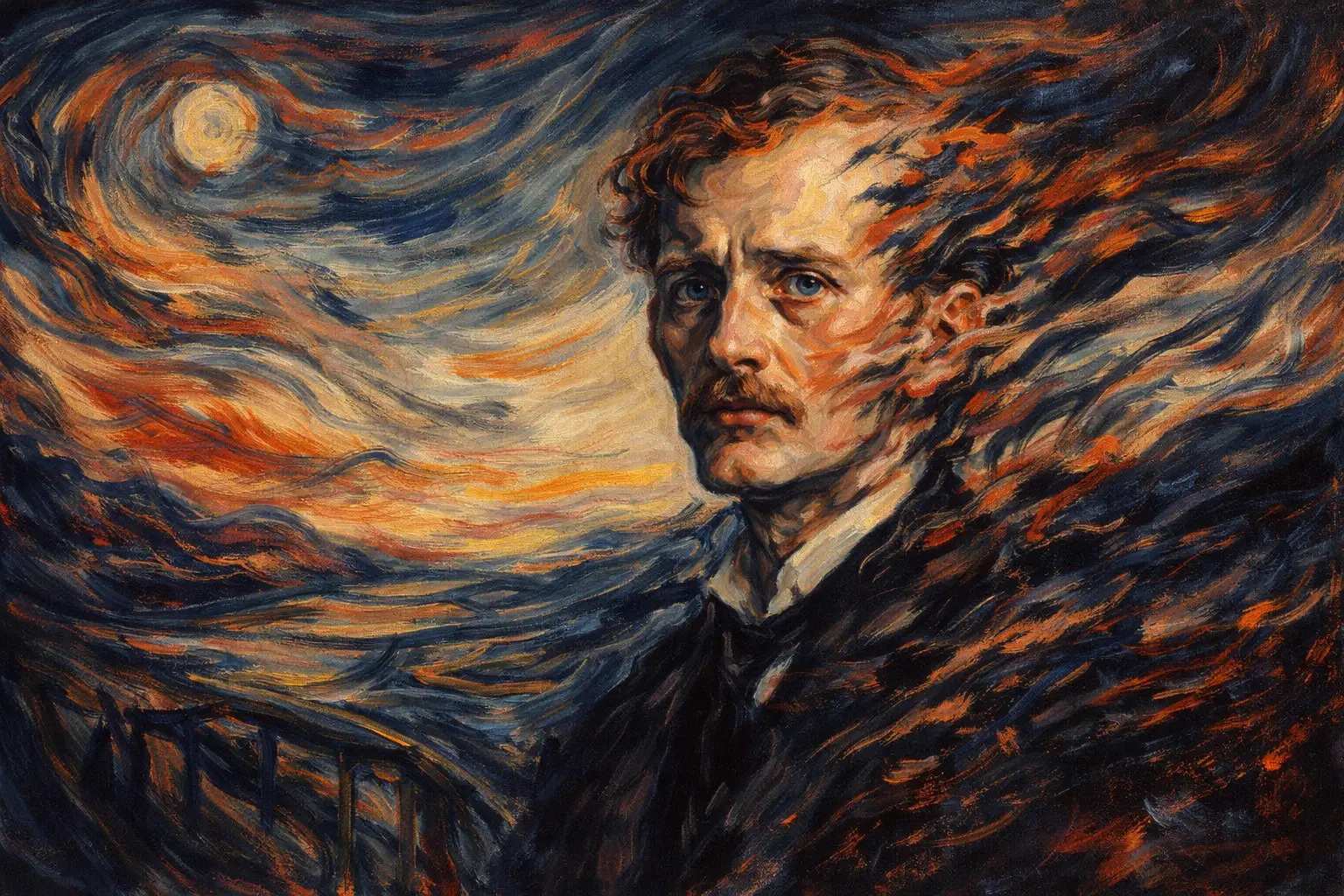
How the art of the famous Norwegian expressionist, who was born on December 12, 1863, changed and was changed by life in Europe in the early 1900s.
The Nordic Crucible: The Birth of an Artist in the Dark and Light
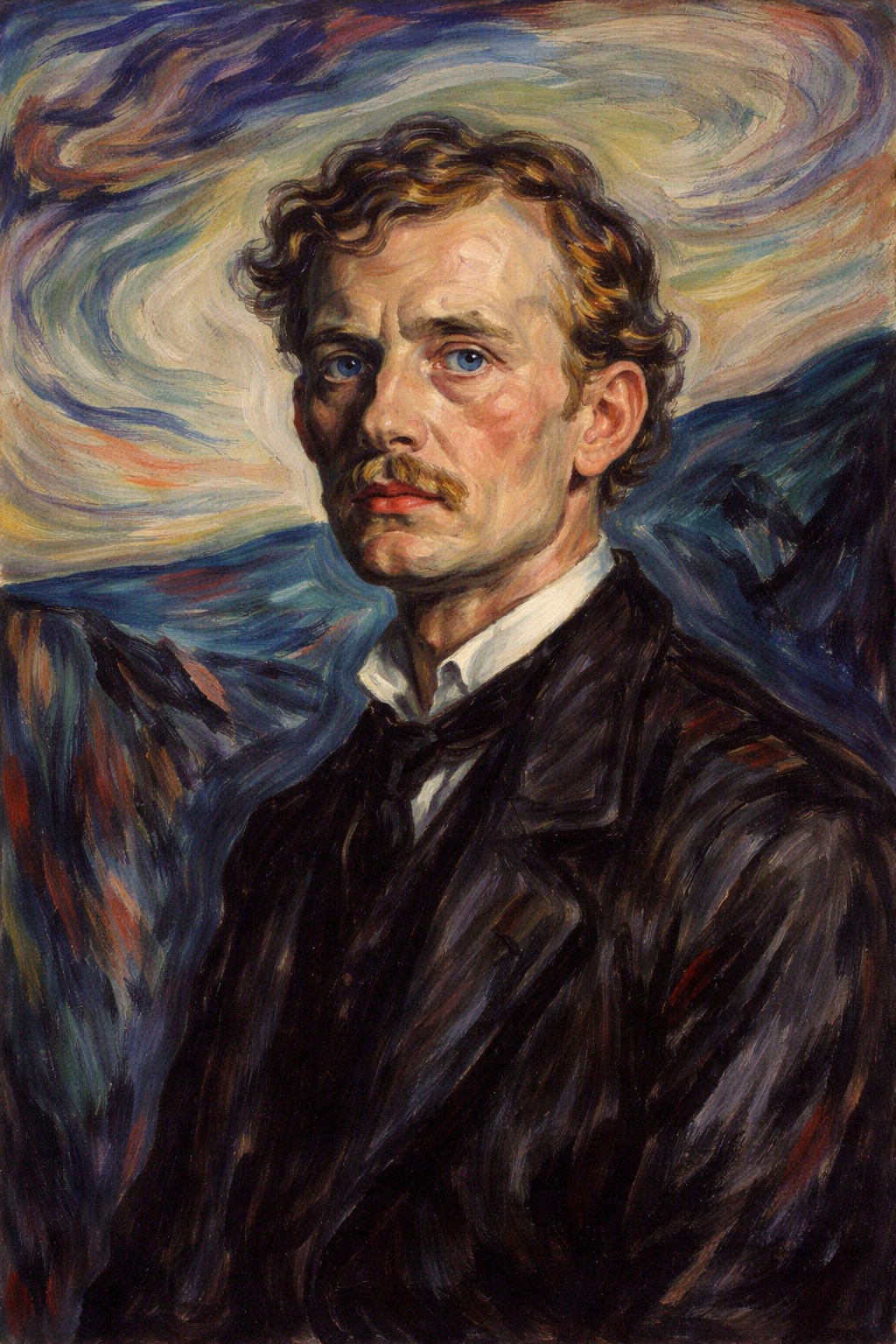 The art of Edvard Munch was inspired by the long, dark winters and bright summers in Norway. When you look at his paintings and those of other young Germans, this is the first thing that comes to mind. The extreme Nordic cycle of seasons, which included months of suffocating gloom and an almost hallucinatory midnight sun, created a psychological landscape that Munch would paint with unmatched intensity. In these northern latitudes, nature is not just a backdrop; it is an actor that pushes on the mind and makes people face their feelings. It is not a coincidence that Munch's most famous painting shows a person who is not scared of something outside of them but of a scream echoing through a bright sky over the Kristiania fjord.
Munch, on the other hand, was more than just a product and expression of his home country. His art was shaped by and shaped by the European reality of the early 20th century, when tensions and radical changes in all areas of human expression led to the rise of artistic movements that went against the established order. His influence can be seen in German Expressionism, Austrian Secessionism, and the larger Symbolist movement. He is one of the two great forerunners of Expressionism, along with Vincent van Gogh. He was an artist who broke through the surface of visual representation to show the raw nerves underneath.
A Childhood Full of Death
People sometimes say that Edvard Munch was born in Oslo, but he was actually born on December 12, 1863, in a farmhouse in the village of Ådalsbruk in Løten, which is a rural area in Norway's interior. The next year, his family moved to Kristiania (the name of Oslo at the time) because his father, Christian Munch, was named medical officer at Akershus Fortress. The family's social standing was complicated and contradictory. They came from Norway's cultural elite—Edvard was related to the painter Jacob Munch and the historian Peter Andreas Munch—but his father's low military pay kept them in genteel poverty. They lived in tenement houses in working-class areas. They couldn't move freely among the educated elite, but they were exposed to the diseases that were killing the poor in cities, like tuberculosis and bronchitis.
Tragedy struck early and kept coming. Laura Catherine Bjølstad, Edvard's mother, got weaker after having her fifth child and died of tuberculosis in 1868, when Edvard was only five years old. Aunt Karen moved in with the Munch family and took care of the house, becoming a surrogate mother for the Munch children. But the worst thing that happened to Edvard was when his beloved older sister, Johanne Sophie, died of tuberculosis at the age of fifteen in 1877. The girl who was dying asked to be taken out of bed and put in a chair. Munch kept that chair until he died nearly seventy years later. His father, a deeply religious and sometimes fanatical Christian, would get very depressed and angry after these deaths. He would often scare the kids by telling them that their mother was looking down from heaven and grieving over how bad they were behaving.
Only one of Munch's five siblings, his younger sister Inger, lived to be an adult. Andreas, his brother, who had seemed unusually strong, died of pneumonia at the age of 30, just after getting married. At a young age, his sister Laura was diagnosed with a mental illness and spent most of her life in a hospital. As a child, Munch often got sick and had to stay in bed for whole winters, missing school. He was later diagnosed with bipolar disorder and had trouble with alcohol for most of his adult life. Munch knew that this never-ending stream of loss and illness would be the basis of his art. "I inherited two of humanity's most terrible enemies: the legacy of consumption and insanity. Illness, madness, and death were the black angels that stood at my cradle and followed me all my life," he wrote in a private journal that was not dated.
From being an engineering student to being a troublemaker
Munch started studying engineering at Kristiania Technical College in 1879. He did very well in physics, chemistry, and math. But art had a stronger pull. He quit engineering in 1880 and went to the Royal School of Art and Design in Kristiania, where he studied drawing with the sculptor Julius Middelthun. He was renting a studio with other young artists by 1882. Christian Krohg, a naturalistic painter and one of the most important figures in Norwegian art at the time, was in charge of the studio.
His time spent with the Kristiania Bohème, a radical group of writers and artists led by the anarchist philosopher Hans Jæger, was just as important. This group wanted free love, the end of marriage, the right to vote for everyone, and an eight-hour workday. Jæger told Munch to stop painting what he saw and instead paint how he felt and thought—what would later be called "soul painting." From this intellectual ferment arose Munch's unique perspective: art not as a reflection of nature, but as a portal into the inner existence of suffering, longing, and fear.
In 1885–1886, his painting The Sick Child caused a scandal in Norway's conservative art circles, which liked academic naturalism and thought Munch's rough, scratched-surface style was too much. The painting, which was a tribute to his dead sister Sophie and showed the bedridden fifteen-year-old next to a sad woman, was attacked with great force. At the show, the young Realist painter Gustav Wentzel and others surrounded Munch and called him a madman. The critic Johan Scharffenberg said that Munch's art was also "insane" because he came from an "insane family." Munch thought the work was a big deal because it was the start of a career that would focus on death, loss, anxiety, and the worries of a troubled mind.
In 1889, Munch went to Paris on a state scholarship. There, he studied with the painter Léon Bonnat and learned about the new ideas of the Post-Impressionists. He was especially interested in the work of Paul Gauguin, Vincent van Gogh, and Henri de Toulouse-Lautrec because they used color in a free way that wasn't just to show what was real. He also came across the Symbolist movement, which would have a big impact on how his taste changed over time. The death of his father that same year caused a major spiritual crisis and sped up his break with naturalism. By the early 1890s, Munch had created a very personal type of Symbolism in which color became the main way to convey meaning.
The "Munch Affair": A Scandal That Launched
In the fall of 1892, Munch went to Berlin at the request of the Verein Berliner Künstler (Association of Berlin Artists) to put on a retrospective show of fifty-five works at the Architektenhaus on Wilhelmstrasse. The Norwegian painter Adelsteen Normann, who lived in Berlin and had seen a Munch exhibition in Kristiania, sent the invitation. He was excited about his colleague's bold and unusual work. For the young Norwegian who was still mostly unknown, the invitation was a big honor because it gave him access to the artistic scene in the German capital.
But the art community in Berlin wasn't ready for what it found. In the early 1890s, prestige and tradition shaped mainstream taste. Kaiser Wilhelm II and the powerful conservative painter Anton von Werner, who led the Association, were both in favor of this. Munch's bright, unfinished paintings hit the art world like a meteorite. The older members of the association were very angry. Max Kruse, the sculptor, later remembered how angry and even furious the established painters were. It was more than what the organizers had expected. The press called the works "anarchistic provocations," and the art historian Adolf Rosenberg wrote a scathing review in the Berliner Tageblatt.
Anton von Werner called an emergency meeting on November 12, 1892, just seven days after the exhibition opened, and forced a vote on whether or not to close it right away. The proposal passed by a vote of 120 to 105. The next morning, the paintings were taken down from the walls. The press called the event "Der Fall Munch" (The Munch Affair), which was ironic because it sparked the most heated cultural debate in the German Empire's art world. Around eighty artists who disagreed with the others left the meeting in a huff and started the Freie Vereinigung Berliner Künstler (Free Association of Berlin Artists) that same night. This group would later become the Berlin Secession. So, the affair not only brought Munch to the world stage, but it also started modernism in Berlin.
Munch, who was not yet thirty, loved the unexpected attention. "It is, by the way, the best thing that could happen; I can have no better advertisement," he wrote home to Norway. Instead of being embarrassed and backing down, he planned for the show to go to Düsseldorf and Cologne before reopening it in Berlin at the Equitable Palast in December. He didn't sell much, but he made a good living just from ticket sales because everyone wanted to see the international scandal. Munch chose to move to Berlin and make it his base of operations because of the social and financial benefits of being famous.
Berlin: The Scream and The Frieze of Life
Munch made some of his most famous works and started his biggest project while living and working in Berlin from 1892 to 1908, when he had a breakdown. The Frieze of Life: A Poem about Life, Love, and Death, a series of paintings that look at the most important parts of being human. In December 1893, the first works in the series, including Melancholy, were shown on Unter den Linden. Death in the Sickroom, Anxiety, Ashes, Jealousy, The Kiss, The Dance of Life, and the controversial Madonna were added to the cycle over the next few years. The whole cycle was not shown until the fifth exhibition of the Berlin Secession in 1902.
One of these works was The Scream, painted in 1893. It would go on to become one of the most famous images in Western art history. Munch wrote about the event that inspired it in a diary entry: "One night I was walking along a path with the city on one side and the fjord below. I was tired and sick, and I could hear a scream in the air. The distorted face of the central figure, the wavy lines of the sky, and the bright orange and red colors made a visual language for existential terror that is still very strong. There are four versions of the painting: two in pastels, one in tempera and crayon, and one in oil. This shows how Munch kept coming back to themes that bothered him. The pastel version from 1895 sold at auction in 2012 for almost $120 million, which was a record price at the time.
Berlin also brought Munch into a lively group of artists and thinkers. He went to the wine bar Zum Schwarzen Ferkel (The Black Piglet) a lot. It was a famous hangout for the city's bohemian avant-garde, and there he met the Swedish playwright August Strindberg, whose plays dealt with themes of intense interpersonal pain that were similar to Munch's art. He also met the Polish writer Stanisław Przybyszewski and the Norwegian cultural figure Dagny Juel, who inspired Madonna and other major works. Munch also stayed in touch with fellow Norwegian Henrik Ibsen by designing sets for Ibsen's production of Peer Gynt in Paris.
Guide to the Expressionists
But Munch's importance went well beyond his own paintings. He was already an intellectual and aesthetic role model, if not a direct mentor, for a group of younger German and Austrian artists who would go on to define Expressionism, even when he lived in Berlin. Ernst Ludwig Kirchner, Erich Heckel, Karl Schmidt-Rottluff, and Fritz Bleyl were the first members of Die Brücke (The Bridge). They were four architecture students who started their revolutionary group in Dresden in 1905. They were inspired by Munch. The Die Brücke painters first saw Munch's work at the Sächsischer Kunstverein in Dresden in 1906. In 1907, Schmidt-Rottluff looked at Munch's prints in the Hamburg collection of the regional court director Gustav Schiefler. He was very impressed by their formal language and expressive power.
Max Beckmann, whose brutally honest allegorical paintings of human suffering would make him one of the most important artists of the 20th century, also learned from Munch how to be emotionally direct. Gustav Klimt, head of the Secession movement, showed Egon Schiele Munch's work at an exhibition in Vienna in 1909. This started a chain of influence that would shape Austrian Expressionism. Schiele's thin, tortured self-portraits, with their twisted bodies and unflinching psychological exposure, would not have been possible without Munch's work.
But what did all these younger artists see in the Norwegian master? First, an almost obsessive need to use art to show feelings in an extreme way—not the soft feelings of Romantic tradition, but the raw feelings of anxiety, desire, jealousy, and fear. Second, a readiness to confront contemporary issues that, at the onset of a new century, introduced revolutionary concepts regarding sexuality, mental health, the supernatural, and idealistic governance. Third, a technical daring that freed color and line from their descriptive roles, turning them into carriers of psychological meaning. Munch's distorted shapes and harsh, unnatural colors showed that the visible world could be intentionally changed to make the invisible, like feelings and thoughts, visible.
Munch was also old enough to have experienced firsthand the legacy of nineteenth-century Romanticism, which focused on the sublime, the terrifying, and the individual's struggle with huge natural forces. His younger peers did not have this experience. At the same time, his lifelong obsession with death and illness, which came from the trauma he experienced as a child, gave his art a dark authenticity that no amount of youthful rebellion could match.
You can see the effect directly in certain works. The 1917 woodcut Man in a Plain by Erich Heckel is similar to The Scream in that it shows compositional pain. The 1910 self-portraits by Egon Schiele clearly use Munch's language of distorted bodies and exposed mental states. Kirchner's famous Street, Berlin (1913), with its acid colors and sharp angles that make city dwellers look like they don't belong, takes Munch's vision and puts it in the chaotic setting of city life before World War I.
The Breakdown and Transformation
Munch's years in Germany were extraordinarily productive but personally devastating. His excessive drinking, restless traveling, and a tumultuous romantic relationship with the Norwegian woman Tulla Larsen spiraled into crisis. In 1908, hearing voices and suffering from paralysis on one side of his body, he collapsed and checked himself into Dr. Daniel Jacobson's private clinic in Copenhagen, where he spent eight months undergoing treatment. For the first time in years, he was completely abstinent.
The breakdown marked a turning point—not the end of his art, but a profound transformation of it. When he left the clinic and returned permanently to Norway in 1909, he took with him his exposure to Expressionism and the full range of artistic ferment he had absorbed in Germany and France, but his style changed, becoming more relaxed and, in many ways, more life-affirming. His color palette brightened, as if the sun had literally risen over his canvases. The anguished intensity of the 1890s gave way to a new engagement with the Norwegian landscape, with scenes of farmers and laborers, and with a natural world depicted not as a stage for psychological torment but as a source of vitality and regeneration.
This transformation found its most monumental expression in the murals for the Assembly Hall (Aula) of the University of Oslo, commissioned in 1909 and completed in 1916. The centerpiece was a vast painting of a dazzling sun, a deliberate and almost defiant embrace of light by an artist who had spent decades exploring the darkest recesses of the human soul. In the newly independent Norway (the country had dissolved its union with Sweden in 1905), Munch was increasingly celebrated as the national artist, alongside the dramatist Henrik Ibsen and the composer Edvard Grieg.
The Master Printmaker: New Ideas in Stone and Wood
Munch worked hard at printmaking throughout his career, but especially from the middle of the 1890s on. Very few artists in history have had the same level of passion for it. He learned how to etch, lithograph, and woodcut, and then he came up with new ways to do them. With about 748 registered print works and between 20,000 and 25,000 individual impressions, he may be the most prolific printmaker in history.
His engravings and woodcuts show a very new way of looking at things. Munch came up with a new way to cut his finished woodblocks into three or four puzzle-like pieces along the lines of pictures. He used a fret saw to do this. He then used a different color of ink on each piece before putting them back together and printing the whole picture in one pass through the press. The result was a strange and hauntingly beautiful effect: figures looked like they were not connected to each other or their surroundings, as if the very fabric of reality had been cut apart and put back together wrong. Instead of the hard cherry wood that is common in Japanese art, he used soft native woods like spruce, pine, birch, and oak. Like Paul Gauguin, who worked alone, he was one of the first artists to use the natural grain of the wood as an expressive element on its own.
He was also the first to use more than one printmaking technique in the same piece. In 1895, he made his masterprints Madonna and Vampire II as lithographs. In 1902, he changed them by adding colored woodcut blocks to make them even more creepy. He tried out hectography, an old method that uses gelatin and special inks, and made more than 500 prints with 100 different designs over the course of almost 30 years.
In a series of woodcuts called "Towards the Forest," you can see the artist's exploratory vision as they use transparent veils of color to make beautiful, fleeting images—landscapes that seem to be somewhere between memory and dream. The Die Brücke artists were heavily influenced by Munch's new ideas about printmaking. They would bring the woodcut back to life in the heart of German Expressionism, making it one of the movement's most important forms of art.
In the Shadow of the Third Reich
Munch bought Ekely, an eleven-acre estate on the outskirts of Oslo, in 1916 for the price of two or three of his paintings. He lived there for most of the rest of his life, but he became more and more alone. He still traveled and made a lot of art, though. Landscapes, portraits—frequently commissioned by industrialists, financiers, and political figures—and depictions of laborers in the Norwegian countryside emerged as his principal subjects, although he occasionally revisited the motifs of love, anxiety, and death that characterized his earlier oeuvre.
When the Third Reich came to power, the Nazis used Munch's and his German friends' art as part of their campaign against modern art. In 1937, Joseph Goebbels gave the go-ahead for the seizure of thousands of modernist works from German museums for the infamous Entartete Kunst (Degenerate Art) exhibition in Munich. This was a propaganda event meant to mock and condemn art that didn't fit with the regime's narrow aesthetic ideology. Works were shown without frames and surrounded by insulting phrases like "madness becomes method." German museums took down 82 of Munch's works and called them "degenerate." Many of his former students and fans were also targeted artists. The police took 759 works by Erich Heckel, 639 by Ernst Ludwig Kirchner, and 508 by Max Beckmann. In 1938, Kirchner killed himself while living in Switzerland. He was heartbroken over the loss of his life's work. On the first day of the show, Beckmann ran away to Amsterdam.
The Degenerate Art exhibition, on the other hand, drew more than two million people to Munich alone. This is more than the Great German Art Exhibition, which was officially approved and held at the same time nearby, which drew fewer than half a million people. Some of the stolen works, like Munch's The Sick Child, which is now in the Tate collection, were sold at auction in Switzerland in 1939. In the yard of Berlin's main firehouse, other people were secretly burned. About a third of the most valuable works of art that were taken were sold to make the regime richer, another third disappeared completely, and only a small number were ever returned to the institutions where they were stolen.
Munch's situation got worse when Germany invaded and took over Norway in April 1940. Norwegian museums had also taken down his paintings and prints. The seventy-six-year-old artist lived in almost complete isolation at Ekely, with almost all of his life's work stored on the second floor of his house. He was always afraid that the Nazis would take it away. The regime tried to use him as a heroic figure of Germanic culture from time to time, but Munch always refused to help or take part in any efforts to get him to join the Third Reich and its Norwegian collaborators.
The Last Years: Painting Until the End
After an explosion at the munitions depot in Filipstad, near Ekely, broke the windows of Munch's house, he got very sick and died. He died just weeks after the explosion, on January 23, 1944, at the age of 80. Even though he wanted a private cremation with no one else there, the Nazi occupation authorities and their Norwegian collaborators under Vidkun Quisling took over his funeral and used it as a chance to spread propaganda. The newspaper Fritt Folk, which supported the government, put an obituary poem by Knut Hamsun on the front page and called Munch a symbol of "our people's best qualities."
The paintings from the last years of his life are a strange and interesting mix of styles and ideas. They look back on the dreams he had as a child—love, death, anxiety, and the ghostly presence of family members who have passed away—but now they are seen through the lens of age and years of technical skill. They remind me of past obsessions, as if they are dimly lit by the darkness of death coming closer. His last self-portrait, Between the Clock and the Bed (1940–42), shows him old and weak, standing in the small space between a grandfather clock and a bed. One critic said he was "hovering on the edge of eternity." It is a painting of brutally honest honesty, with no pretense. It's as if the man who had spent sixty years studying the human soul had finally turned the knife on himself.
Munch left his huge estate to the Municipality of Oslo in his will. This included more than 1,000 paintings, about 15,400 prints, a lot of their original plates, 4,500 watercolors and drawings, and six sculptures. The Munch Museum opened in Oslo in 1963, on the 100th anniversary of his birth. This made sure that the art that came from Norway's dark and light would always be available to the world.
Munch once said, "Just as Leonardo da Vinci studied human anatomy and cut up bodies, I try to cut up souls." The scalpel he used, with its color, line, and rough-hewn wood grain, cut so deep that it changed the course of art itself.