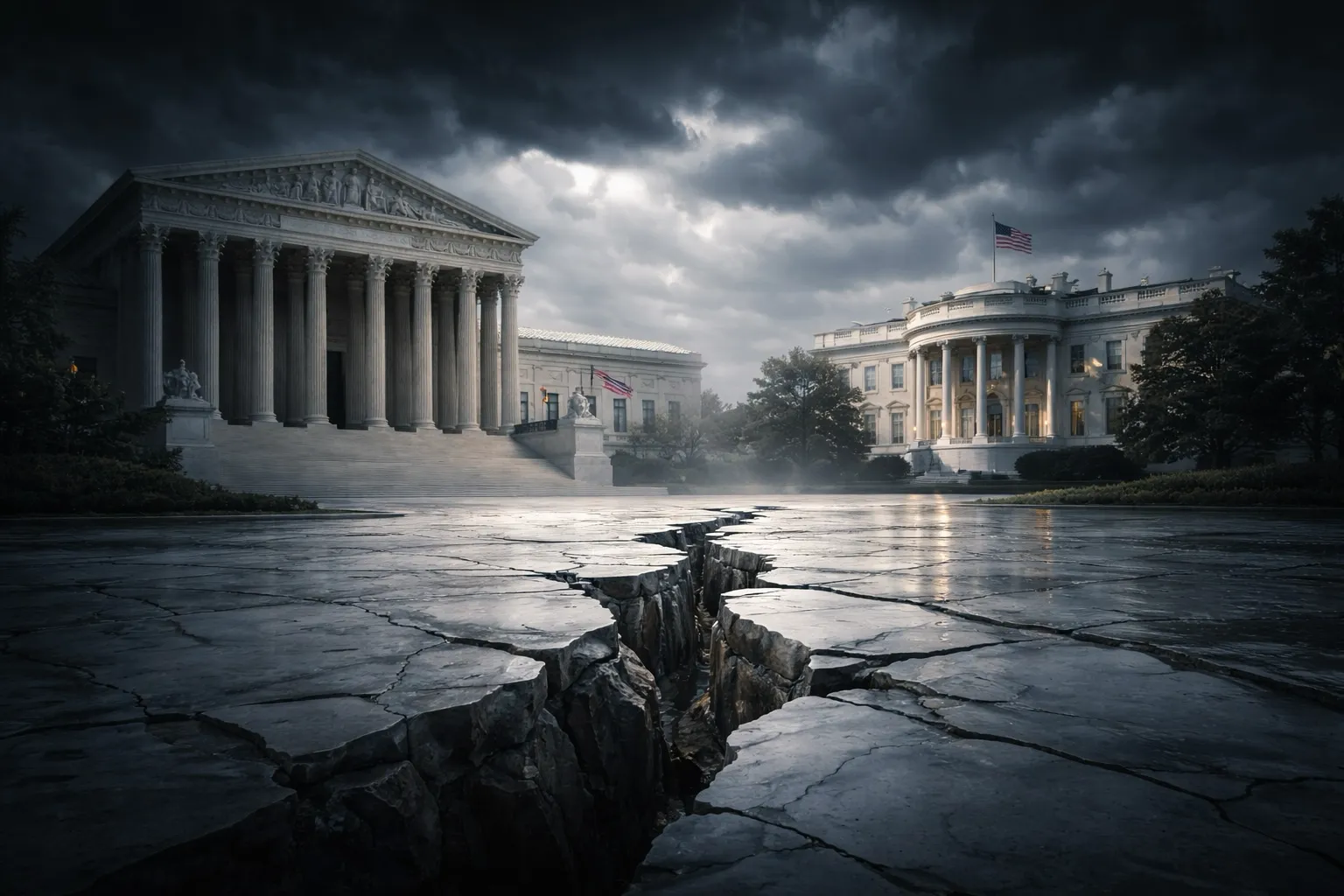
For almost ten years, Donald Trump saw the Supreme Court as a strong, trustworthy partner and an important part of the government. He is responsible for getting three of the Court's six conservative justices their seats: Neil Gorsuch in 2017, Brett Kavanaugh in 2018, and Amy Coney Barrett in 2020. By any standard, the way Trump changed the courts was the most important thing that happened during his first term.
The dividends looked huge. The conservative 6–3 majority's decisions about presidential immunity and a string of urgent appeals during his second term made people think that they would rarely, if ever, stop an American president who won the White House in a landslide. In about two dozen emergency docket decisions since January 2025, the Court agreed with Trump on immigration enforcement, shutting down federal agencies, making big cuts to government spending, and firing the heads of independent regulatory bodies. Some people say that the president won about 80% of the emergency appeals he made.
Then, on February 20, 2026, the decision in Learning Resources, Inc. v. Trump ended the streak for good.
The Case: How Small Businesses Stood Up to a President
The case combined two lawsuits: Learning Resources, Inc. v. Trump and V.O.S. Selections v. United States. Small businesses, manufacturers, and retailers, along with several state attorneys general, filed these lawsuits. The plaintiffs said that Trump had gone too far when he used the International Emergency Economic Powers Act (IEEPA), an emergency law from 1977, to put high tariffs on imports from all over the world.
Trump used IEEPA to back up his "Liberation Day" tariffs, which he announced with a lot of fanfare in the Rose Garden on April 2, 2025. These "reciprocal" tariffs raised duties on imports from China by as much as 145% and on major trading partners like India and Brazil by as much as 50%. The White House said that the words "regulate" and "importation" in the law clearly gave the government the power to set tariffs.
The companies that are fighting the tariffs said that the words "tariff" and "duty" don't appear anywhere in IEEPA, and that no president has ever used the law to give them the power to set tariffs in the almost 50 years it has been around.
The administration's legal journey was quick and harsh. The IEEPA tariffs were ruled illegal by the U.S. International Court of Trade on May 28, 2025. The U.S. Court of Appeals agreed with that decision on August 29, 2025. In September, the Supreme Court agreed to hear the cases, combined them, and heard oral arguments on November 5, 2025. People who were watching the court said that most of the justices were very doubtful of the government's reasons during oral argument.
The hammer fell on February 20, 2026.
The Decision: "Those Words Can't Handle That Much Weight"
The Supreme Court ruled that the president went too far with a vote of 6–3. The majority opinion was written by Chief Justice John Roberts, with Justices Sotomayor, Kagan, Gorsuch, Barrett, and Jackson joining him. Justices Thomas, Alito, and Kavanaugh were the ones who disagreed.
Roberts' opinion was well thought out and very damaging. He said that the president's claim to be able to set tariffs on his own was based on only two words in IEEPA, which were separated by sixteen other words. Roberts wrote, "Those words can't handle such weight." He said that the U.S. Code has hundreds of laws that give the Executive the power to "regulate" different areas, but the government couldn't find a single case where the power to regulate was understood to include the power to tax.
Roberts also said that if IEEPA's language were to be interpreted to include tariff authority, it would make part of the law unconstitutional. This is because IEEPA gives power over both importing and exporting, and the Constitution says that taxes on exports are illegal.
Roberts used the "major questions doctrine," a rule that says Congress must clearly approve policies that have a big impact on the economy and politics. He quoted the Trump administration's own brief, which said that the president himself said that the stakes were high: "we are a rich nation" or "a poor one." Roberts came to the conclusion that those very stakes needed clear congressional approval, which IEEPA does not give.
Justice Gorsuch agreed with the majority in a separate opinion. He stressed that the president was claiming a "extraordinary power"—the ability to impose tariffs on "practically any products he wants, from any countries he chooses, in any amounts he selects"—that Congress had never clearly given him.
Justice Kavanaugh, who disagreed with the ruling, said it created a "practical nightmare" because the government may now have to give back billions of dollars it has already collected from importers, but there is no clear way to do this. He said that the Court didn't say anything today about whether or not the government should return the billions of dollars, and if so, how.
The Numbers: An Earthquake Worth a Trillion Dollars
The money aspects of this decision are mind-boggling. The Tax Foundation says that the IEEPA tariffs, which are now against the law, would have brought in $1.4 trillion over the next ten years. The most recent data point, December 14, 2025, shows that the government had received $133.5 billion in IEEPA tariff payments from U.S. importers. The number is thought to have grown to at least $160 billion by the time the ruling came out.
The question of refunds is now the next big issue in the legal world. Morgan Stanley thought the government would probably pay back about $85 billion to the people who were hurt. RSM analysts put the number between $100 billion and $130 billion, while Raymond James put it even higher, at about $175 billion, which is in line with what the University of Pennsylvania said. The United States International Trade Court has been given the case back to deal with the issue of the refund.
Companies were already in line. FedEx was one of the first companies to file a lawsuit asking for a full refund. State governors, like Illinois' J.B. Pritzker and California's Gavin Newsom, asked the administration to send refund checks to American families. Pritzker said that the damage was about $1,700 per household in Illinois, which would add up to $8.7 billion for his state alone.
The Tax Foundation said that Trump's tariffs, when added together, were the biggest tax increase in the U.S. as a percentage of GDP in more than 30 years. In 2025, the average tax increase per household was $1,000, and in 2026, it was $1,300, mostly because of the now-invalidated IEEPA tariffs.
The Response: "I'm Done Being Nice to the Court"
On Friday morning, while meeting with governors at the White House, Trump got the news about the ruling in a handwritten note. A governor who was there said that after reading it, he said out loud, "that's a disgrace," and then left the room soon after.
That afternoon, in the White House briefing room, the president gave the Court's majority a harsh speech at a press conference. He said he was "deeply disappointed" by the decision and that he was "ashamed of certain members of the court, absolutely ashamed for not having the courage to do what's right for our country." He called the six justices in the majority, two of whom he had appointed himself, Gorsuch and Barrett, "very unpatriotic and disloyal to the Constitution" and said they had been "swayed by foreign interests."
He praised the three dissenters a lot, saying, "I'd like to thank and congratulate Justices Thomas, Alito, and Kavanaugh for their strength, wisdom, and love of our country. Right now, our country is very proud of those justices."
He then said, "I'm done being nice to the Court."
Hours later, Trump signed an executive order that put a new 10% "global tariff" in place under Section 122 of the Trade Act of 1974. This was a different legal authority that the ruling did not address. He had already raised it to 15% by the next day. But Section 122 has its own problems: it limits tariffs to 150 days and needs a vote from Congress to be extended, which Senate Democrats could filibuster.
Trump talked about the ruling at the State of the Union address the next Tuesday, in front of four justices who were sitting still in the front rows. He said that "the Supreme Court's unfortunate involvement" was wrong and that tariffs would eventually "substantially replace the modern-day system of income tax." This was a huge exaggeration, economists said. Tariff revenue was only about $30 billion a month, which is a small amount compared to income tax receipts.
The Decision of Wall Street
The markets reacted in a good but cautious way. The S&P 500 rose 0.69% to close at 6,909.51 on the day of the ruling. The Nasdaq Composite rose 0.9%, and the Dow Jones Industrial Average rose 230.81 points (0.47%) to close at 49,625.97. Amazon, which gets a lot of its goods from other countries, went up by almost 2.6%. The Dow Jones Transportation Average went up by about 1%.
But by Sunday night, futures had dropped because Trump's quick announcement of new tariffs added to the uncertainty. At first, the U.S. dollar rose against other major currencies, but by the end of the day, it had fallen. Treasury yields rose, with the 10-year bond reaching 4.09%.
There was disagreement among analysts. Some people thought the ruling took away a key overhang. Some people said that the administration's determination to find other legal ways to deal with the tariff issue meant that it was far from over. Tobin Marcus of Wolfe Research said, "We fully expect that the tariffs will be reconstituted under other authorities." Polls showed that most people were very against tariffs. An ABC News/Washington Post/Ipsos poll found that 64% of Americans disapproved of how Trump handled tariffs, while only 34% approved.
The White House Missed the Warning Signs
There was a reason for the tariff ruling. During Trump's second term, there were signs that the Court, while mostly supportive, had limits.
The Supreme Court said in December 2025 that Trump did not have the power to send the National Guard to American cities whenever he wanted. The Court said that the power to federalize the National Guard probably only applied in "exceptional" situations, so his plans to send troops to Chicago and Portland, Oregon were put on hold for a while. After that, Trump called off the deployments.
The Court had also been careful when it came to the Fed's independence. The Court made a broad ruling in May 2025 that presidents could fire heads of independent agencies. However, it made an exception for the Federal Reserve, calling it a "uniquely structured, quasi-private entity" with a "distinct historical tradition." Justice Sotomayor wrote the dissent for the liberal justices in that case. She said that the majority's logic would also apply to the Fed, which the majority went out of its way to deny.
The Roberts Problem
It's hard to say how ironic this story is. In 2024, Chief Justice Roberts wrote the historic decision that gave Trump broad criminal immunity. This decision made it easier for him to return to the White House by protecting him from ongoing prosecutions. The Court also stopped states from trying to keep Trump off the ballot because of the insurrection clause in the 14th Amendment. Roberts had, in effect, built a lot of Trump's legal defenses.
But tariffs went against a different constitutional principle that Roberts has always supported: the separation of powers. Article I, Section 8 of the Constitution says that Congress has the power to tax. Roberts' opinion in Learning Resources is as much a defense of congressional powers as it is a criticism of executive overreach. The decision is based directly on what happened during the Biden administration, when Roberts led the Court in striking down the student loan forgiveness program on "major questions" grounds.
In this way, Roberts is not inconsistent. He has a clear idea of what a powerful but not unlimited presidency should look like, working within clearly defined legal limits. Even though it hurt the president directly because he promoted two of the justices who voted with him, the tariff decision fits with that.
The Next Places to Battle
The fight between Trump and the Court isn't just about tariffs. There are still two big cases that need to be decided this term, and each could have big effects.
Trump vs. Cook: The Federal Reserve
Trump said on Truth Social in August 2025 that he had fired Lisa Cook, the first Black woman to serve on the Federal Reserve Board of Governors, because of claims of mortgage fraud. Federal housing official Bill Pulte was the first to make the claims that Cook had named two different properties as her main residence when she took out mortgage loans in 2021. He had made similar claims against other Trump political opponents, such as New York Attorney General Letitia James and Senator Adam Schiff.
Cook denied the charges and took the firing to court. Judge Jia Cobb gave Cook a temporary injunction that let him stay at the Fed. The appeals court agreed with that choice. When the Trump administration asked the Supreme Court for emergency help, the justices put off making a decision until October 2025 and set a date for full oral arguments for January 21, 2026.
The arguments were a big show. Jerome Powell, the head of the Federal Reserve, was in court with Cook. He is also being investigated for a crime that has nothing to do with the renovation of the Fed's headquarters. Later, Powell said the case was "maybe the most important legal case in the Fed's 113-year history." A letter signed by 593 economists and a few Nobel Prize winners had warned that firing Cook would hurt people's trust in "one of America's most important institutions."
Several people who were watching said that the justices seemed to doubt the administration's point of view. Justice Barrett said that letting Cook respond to the claims "wouldn't be that big of a deal." Roberts also seemed doubtful. A decision is expected to be made by the end of June 2026.
The case has effects that go far beyond just one governor. If Trump can fire Fed governors without a good reason, he could replace Cook with someone he chooses and take control of the institution that sets U.S. interest rate policy. This is something that Wall Street has been very worried about.
Barbara and Trump on Birthright Citizenship
On January 20, 2025, Trump's first day back in office, he signed an executive order that tried to stop babies born in the U.S. to parents who are undocumented or only here temporarily from automatically becoming citizens. The order goes against the Citizenship Clause of the 14th Amendment, which was passed in 1868 after the Civil War to make sure that people who had been slaves could become citizens. The Supreme Court upheld this clause in United States v. Wong Kim Ark in 1898.
Every federal judge who has looked at the order has said it is against the law. The lawsuits were combined into Trump v. Barbara, a nationwide class action brought by the ACLU and partners on behalf of all babies who would be affected. The Supreme Court said it would hear the case in December 2025 and set a date for oral arguments for April 1, 2026. By the end of June or the beginning of July, a decision should be made.
Many people see this case as a test of the Constitution. The birthright citizenship challenge is different from the tariff case because it directly challenges the Constitution's text. Legal experts from all sides of the political spectrum have said that Trump's position is historically untenable. However, the administration says that the phrase "subject to the jurisdiction thereof" was never meant to include children of unauthorized immigrants.
If the Court strikes down the executive order, it would be another big blow to presidential power and make things even worse between Trump and the courts.
The Big Picture: A New Age for the US Government
The fight between Donald Trump and the Supreme Court is more than just a case of institutional tension. It could signal the start of a completely new chapter in the relationship between the executive and judicial branches.
First, the tariff ruling strengthens the idea that the president directly questions the legitimacy of institutions when they don't agree with him. Trump's words, "ashamed," "disgrace," "unpatriotic," "disloyal," and "swayed by foreign interests," are different from what other presidents have said about the Court. It shows that you are willing to make the courts less legitimate.
Second, the Roberts Court seems to be trying to find a delicate balance between giving the president a lot of power and drawing hard lines when Congress's most important constitutional rights are at stake. The tariff ruling, the order to send in the National Guard, and the careful handling of the Fed case all point to a court that is willing to give the president a lot of freedom, but not a blank check. If this line holds, the rest of the decisions this term, about the Fed and about birthright citizenship, will be like a constitutional referendum on the limits of the presidency.
Third, on a political level, the split may actually help Trump with his base. His talk about the "deep state," "unelected elites blocking the will of the people," and "institutional sabotage" is best shown by the fact that the Supreme Court, including his own appointees, ruled against him. Trump has shown time and time again that he can turn losses in institutions into calls to action. The math is more complicated than usual, though, because the midterm elections are coming up and his approval rating on tariffs is very low (64% disapproval). Republican lawmakers are already in a tough spot: they can either stay loyal to Trump and share the blame for the economy going bad or go with what the public wants and risk making him angry.
Fourth, the stakes for institutions are higher than they have ever been in modern history. This term, the Court is dealing with a lot of different issues, including tariff authority, Fed independence, and birthright citizenship. This is a full test of the constitutional order. The main question in each case is the same: Are there things that a president can't do without Congress?
The Roberts Court's growing answer seems to be, "Yes, and we'll show you where the line is."
For a president who was used to winning, saw the Court as an extension of his political coalition, and once said that his judicial appointments were some of his best work, the tariff ruling was more than just a legal setback. This was a reminder that the structure of the Constitution has its own logic that doesn't change for any president, no matter how many judges he appoints.
The question now is not if Trump will keep pushing the limits. The question is whether the Roberts Court will keep enforcing them and, if so, how much it will cost the institution itself.