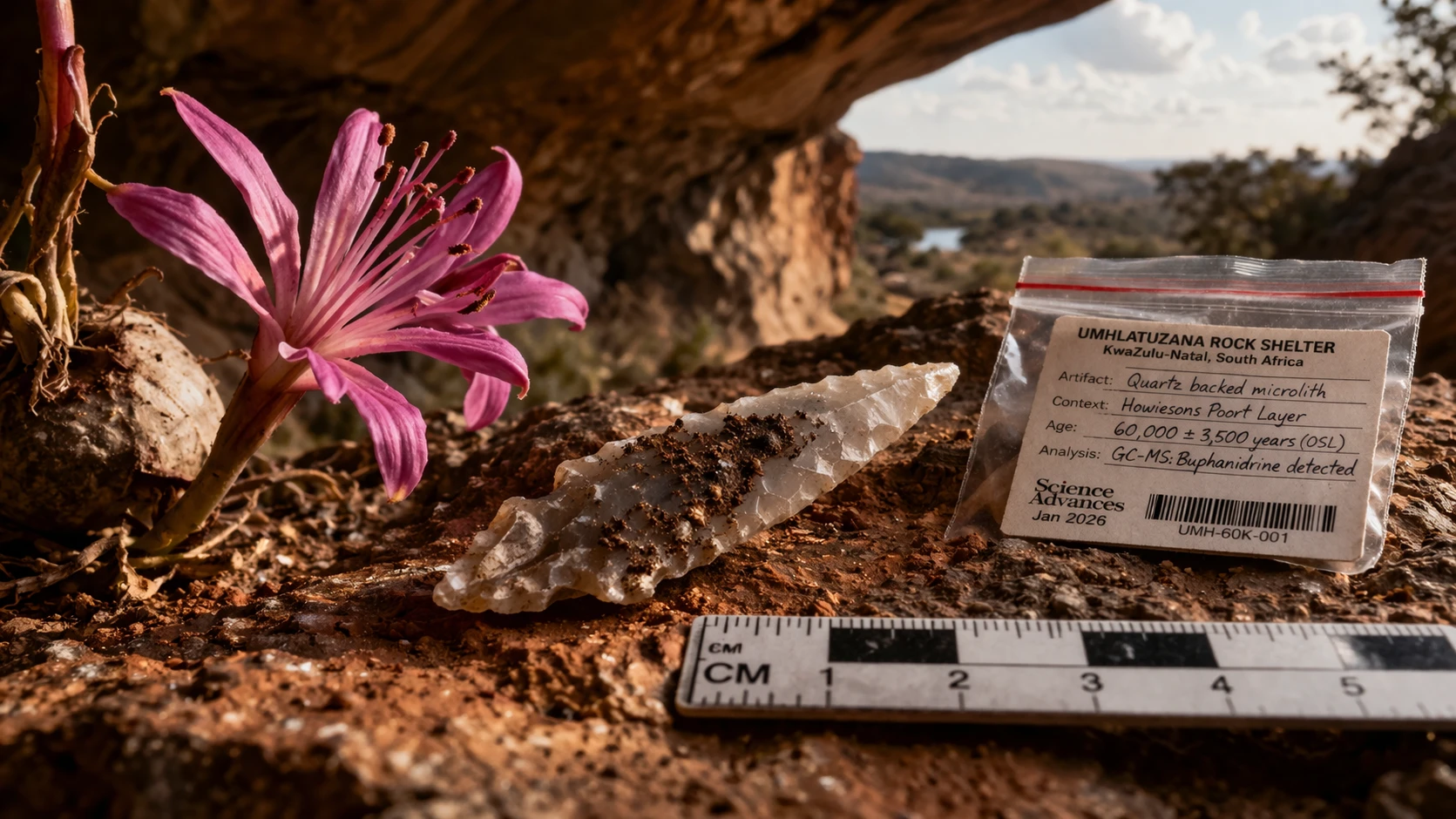
Civilization is not where the story of human ingenuity starts. It starts in the distant past, when our ancestors carved rock shelters into sandstone cliffs and used incredibly advanced tools to solve the basic problem of staying alive. A groundbreaking study that came out in January 2026 in Science Advances has now given us the strongest proof yet that early Homo sapiens were not just resourceful scavengers or brutal hunters. They were also applied chemists, ecological strategists, and long-range planners who thought at the same level as we do.
Researchers from South Africa and Sweden have found chemical traces of plant-based poison on quartz arrowheads that are 60,000 years old and were found in the Umhlatuzana Rock Shelter in KwaZulu-Natal, South Africa. The find is the oldest direct proof of poisoned weapon use in the world, pushing back the confirmed timeline for this technology by more than 50,000 years. The oldest known poisoned arrows were found in Kruger Cave in South Africa, which was about 7,000 years ago, in the middle of the Holocene. The difference between these two pieces of data is huge, and it changes a big part of the story of how technology has changed over time.
A Rock Shelter with a History of 70,000 Years
The Umhlatuzana Rock Shelter is on a steep cliff about 60 meters above the Umhlatuzana River, close to the Hillcrest suburb in KwaZulu-Natal. The shelter itself is an amazing natural structure that is 47 meters long, 8 meters wide, and 17.5 meters high. It was carved out of the quartz arenite sandstone of the Ordovician Mariannhill Formation. The site is naturally protected from direct rain because it faces northeast and is surrounded by plants. This was very important for keeping organic remains intact for tens of thousands of years.
Dr. Rodney Maud found the site in 1982 while building the Mariannhill Toll Road on the N3 Johannesburg-Durban highway. In 1985, archaeologist Jonathan Kaplan did a rescue excavation. He dug a six-square-meter trench that went down to bedrock at a depth of about 2.5 meters. Kaplan found a long and detailed sequence of stone tools that date back to the Middle Stone Age and go all the way up to the Later Stone Age. This is a continuous record of human habitation that goes back about 70,000 years.
For decades after the first dig, the collection stayed mostly the same. Kaplan had said that the Pleistocene deposits looked like they were all the same in terms of layers, but they might have been disturbed, which made him question the site's archaeological context. A new team from Leiden University, led by Gerrit Dusseldorp, didn't start a high-resolution geoarchaeological study until 2018. They used cluster analysis on the three-dimensional distribution of artifacts and sedimentological data to show that there had been no large-scale sediment translocation. The stratigraphic integrity of the deeper deposits was, in fact, much better preserved than people had thought before. This new look at things made it possible for the chemical tests to happen.
The Howiesons Poort: A Time of Change in Thinking
The arrowheads in the middle of this find come from deposits linked to the Howiesons Poort cultural tradition, which is one of the most interesting things that has ever been found in archaeology. The Howiesons Poort is named after a rock shelter in the Eastern Cape that was first dug out in 1927 by Reverend P. Stapleton and John Hewitt. It shows a time when early Homo sapiens in southern Africa were making a lot of cultural and technological progress quickly, from about 65,000 to 59,000 years ago.
The Howiesons Poort is so special because it has behaviors that archaeologists usually only find in much later periods. During this time, toolmakers made backed microliths, which are small stone blades with geometric shapes that were meant to be hafted onto composite weapons like arrows. They transported fine-grained raw materials over long distances, which suggests that they had complex trade networks or long foraging ranges. They carved abstract geometric shapes into ostrich eggshell containers, which are some of the oldest examples of graphic symbolic expression in the world. At Diepkloof Rock Shelter in the Western Cape, engraved eggshells can be found in at least eighteen different stratigraphic layers. This shows that this was not a one-time thing but a long-lasting tradition that was passed down through the years.
The Howiesons Poort period also saw the first bone tools, the regular use of ochre as a pigment (probably for body decoration with symbolic meaning), and the making of shell beads. In KwaZulu-Natal's Sibudu Cave, archaeologists have found polished bone points that are more than 61,000 years old and have marks from use that are typical of tools used to work with hides. Artifacts from this time period that have been backed have been found all over southern Africa, from coastal areas to inland mountains. Morphometric analyses have shown that they were made to a very similar template over long distances, which suggests that people were connected socially and culturally over long distances.
In the bigger picture of innovation, finding poison-tipped arrows at Umhlatuzana is like finding a missing piece in a mental puzzle. People already knew that the Howiesons Poort was a time of very complicated behavior. We now know that this complexity also applied to pharmacology.
The Chemistry of Old Poison
Professor Sven Isaksson of Stockholm University's Archaeological Research Laboratory, Professor Anders Högberg of Linnaeus University, and Professor Marlize Lombard of the University of Johannesburg's Palaeo-Research Institute all worked together on the study. The team chose ten quartz-backed microliths from the 60,000-year-old site at Umhlatuzana. All of them had visible residues on their surfaces. Optically stimulated luminescence (OSL) dated the deposits from which these artifacts were found to be between 60,000 and 3,500 years old.
The researchers used gas chromatography–mass spectrometry (GC-MS) to look for chemical biomarkers in the residues. Five of the ten artifacts tested positive for buphanidrine (1,2-didehydro-3α,7-dimethoxycrinan), a toxic alkaloid found in plants of the Amaryllidaceae family that grow naturally in southern Africa. One of these five also had epibuphanisine (1,2-didehydro-3α-methoxycrinan), which is a compound that is similar in structure. Both alkaloids are crinane-type compounds that give off different electron ionization mass spectra, which makes it easy to tell them apart.
Boophone disticha, a bulbous flowering plant that grows in much of sub-Saharan Africa, from South Sudan to the southernmost tip of the continent, is the most likely source of these compounds. The plant is easy to spot because of its fan-shaped leaves and bright pink flowers with six petals. People in the area call it gifbol, which means "poison bulb." The bulb, which is the size of a fist and sticks out half way above the ground, has a strong mix of alkaloids like buphanidrine, buphanisine, buphanamine, lycorine, and crinamidine. The name of the genus tells the story: Boophone comes from the Greek words bous ("ox") and phontes ("killer of"), which means that eating it can kill livestock.
The chemical stability of buphanidrine was important for its survival for over 60,000 years. The molecule was hard to break down because it was not very lipophilic, did not dissolve well in water, was structurally rigid, and did not have any hydrogen bond donors. The relatively dry conditions in some sedimentary layers at Umhlatuzana, especially what Kaplan first called the "red brown sand" deposits, made it easier for organic matter to stay intact.
To validate these results, the researchers conducted the identical GC-MS protocol on two additional control sets. First, they looked at arrowheads that European travelers brought back from southern Africa in the 18th century. Some of these arrowheads probably came from the Swedish botanist Carl Peter Thunberg's trip to the Cape hinterland from 1772 to 1774. These old arrows also had buphanidrine and epibuphanisine in them. Second, they looked at extracts from the bulbs of modern Boophone disticha plants and found that the same alkaloids are present in the living species. The chemical match between the three sample sets—archaeological, historical, and modern—forms an exceptionally strong chain of evidence.
How Poison Changed the Hunt
To understand why poison-tipped arrows were important, you need to know how hunting with small stone-tipped projectiles works in terms of physics and physiology. A backed microlith attached to an arrow shaft is a very precise tool, but it is not a weapon that can cause a lot of damage. A quartz arrowhead alone might hurt but not kill big game like antelope, wildebeest, zebra, or even giraffe. The arrow makes a small hole in the skin that lets the poison into the blood. From that point on, chemistry does what momentum can't.
Toxins from Boophone disticha work slowly. In contemporary experimental settings, rats have succumbed to B. distichacompounds within approximately 30 minutes. The timeline would have been much longer for bigger prey animals. The poison would slowly make the animal weaker, making it sick, hard to breathe, see, and move its muscles, but it wouldn't kill it right away. This meant that Howiesons Poort hunters who used poisoned arrows would have used a type of persistence hunting: they would have shot the animal and then followed it, sometimes over long distances, until the poison took full effect.
This hunting strategy has deep cognitive effects. The hunter needs to know that the poison won't work right away; this requires abstract thinking about cause and effect. The hunter needs to be patient and ready to spend time tracking instead of expecting to kill right away. The hunter also needs to know that the prey animal will eventually get weaker and die, even though the wound looks small. This isn't something that comes naturally. It is strategic planning based on what we know about drugs.
The process of making the product required a lot of different kinds of knowledge. Hunters had to find the right plant species among the many different types of plants that grow in southern Africa. They had to know how to get the poisonous exudate out of the bulb. They could either stab the bulb and catch the secretion or cut it and put the liquid in a container. The poison may have become more concentrated when it was exposed to heat or sunlight. It then had to be put on the arrowhead, possibly mixed with an adhesive compound. The way the residue is spread out on the Umhlatuzana artifacts suggests that the toxin was mixed with an adhesive material that had resin or water-soluble gum mixed with ochre, which was used to hold the stone point to the shaft.
According to Curtis Marean of Arizona State University, who was not involved in the study, the combination of microlith technology and poison use may not be a coincidence. The miniaturization of stone tools was a big step forward in its own right. Smaller, lighter points could be shot from a bow at a faster speed, and the invention of poison may have been what made these small projectiles deadly enough to be useful against big game.
A 60,000-Year-Old Way of Knowing
The most striking thing about the Umhlatuzana discovery is how consistent it is. European travelers in the 18th century also found the same Boophone disticha poison on arrows that were 60,000 years old. Carl Peter Thunberg, a Swedish botanist who traveled through the Cape hinterland in the 1770s, wrote that native hunters used the fist-sized root of what he called Amaryllis disticha (later changed to Boophone disticha) to poison their arrows to hunt springbok and other animals.
The San and Khoe people of southern Africa still used Boophone disticha as an arrow poison well into the modern era. But their connection to the plant went far beyond the hunt. The Khoisan knew that Boophone was a very powerful substance. They wouldn't talk about its properties in public, and they wouldn't bother the bulbs when they found them growing in the wild. This is very different from how they interacted with other medicinal plants. A 2,000-year-old Khoisan mummy found in the Baviaanskloof Mountains of the Eastern Cape, wrapped in Boophone scales, shows that the bulb's scales were used to embalm the dead. Traditional healers used very small amounts of drugs to cause hallucinations as a form of psychological treatment. This required very careful control of the dose, as too much could lead to coma or death.
It's still not clear whether people have always known that Boophone was an arrow poison for the whole 60,000 years or if they rediscovered it on their own several times. As Isaksson pointed out, there is no way to know right now if poison use was a common thing that died out and then came back. The research team intends to examine younger deposits at Umhlatuzana to ascertain the presence of poison residues in intervening time periods, potentially aiding in the resolution of this inquiry.
In either case, the effects are big. If the knowledge was passed down from generation to generation, it is one of the longest-lasting cultural traditions in human history, a body of ecological and pharmacological knowledge that has been passed down through 2,500 generations. If it was found again on its own, it shows how rich the southern African environment is and how often the people who live there can find, extract, and use toxins that are already there.
Reconsidering Early Human Cognition
The Umhlatuzana findings emerge during a critical reevaluation of the archaeology of early human cognition. For most of the 20th century, the prevailing narrative posited that genuinely modern human behavior—symbolic thought, intricate planning, and technological innovation—emerged relatively recently, approximately 40,000 to 50,000 years ago, and was chiefly linked to the Upper Paleolithic period in Europe. The African archaeological record has methodically deconstructed this framework.
The Howiesons and Still Bay The traditions of the Poort people in southern Africa, which date back about 77,000 to 59,000 years, show that modern humans' full range of behaviors developed in Africa tens of thousands of years before similar evidence was found in Europe. In the Middle Stone Age of southern Africa, people did things like heat treat stone to make it less likely to flake, pressure flake bifacial points, make compound adhesives, engrave abstract symbols, make personal ornaments, and make bedding from medicinal plants.
Finding poison arrows adds a very important new part to this picture. The study authors assert that poison operates chemically rather than as a physical force, indicating that the hunters who employed it must have depended on advanced planning, abstraction, and causal reasoning. This is very different from, say, making a spear point sharper. A sharper edge makes cutting easier right away. To understand poison, you need to know about an invisible process that happens when a substance gets into the blood and causes effects that last for hours. The hunter can't see how the poison is working. They have to have faith in a process that they can understand in theory but not see in action.
This ability to think abstractly about cause and effect, along with the knowledge of ecology needed to find the right plant, the technical skill needed to extract and use the toxin, and the patience needed to follow weakened prey over long distances, shows a group of cognitive skills that are completely modern. Ludovic Slimak of the French National Centre for Scientific Research said that the finding also supports the idea that the bow and arrow wasn't a new invention but a basic and complicated technology that has been around for at least 80,000 years in Africa and Asia. It came with Homo sapiens when they came to Europe about 54,000 years ago.
New Frontiers in the Study of Organic Residues
The Umhlatuzana study not only sheds light on early human cognition but also pioneers a new methodological approach. Most of the time, archaeologists have thought that organic materials like plant remains, animal fats, and adhesives can't last more than a few thousand years in the archaeological record. The presence of identifiable alkaloid molecules on 60,000-year-old stone tools illustrates that, under optimal preservation conditions, delicate organic compounds can endure significantly longer than previously assumed.
This discovery may have far-reaching effects on the field. If toxic plant alkaloids can last for 60,000 years, then other organic materials, like medicinal plant compounds, food processing residues, and adhesive formulations, may also be found in deep archaeological sites. Using GC-MS and other biomolecular analytical techniques on Middle Stone Age assemblages could show us things about how early humans acted that we couldn't see with traditional archaeological methods, which mostly look at long-lasting materials like stone, bone, and shell.
The research team has indicated its desire to broaden the inquiry. Future research will focus on younger deposits at Umhlatuzana to determine whether the use of poison was consistent or intermittent. Other promising Middle Stone Age sites in southern Africa may also have materials that can be analyzed in the same way. If poisoned arrows were used at Umhlatuzana 60,000 years ago, it's very likely that this practice was more common and maybe even older than this one site can show.
The Molecular Smoking Gun
The poisoned arrowheads from Umhlatuzana Rock Shelter, which are 60,000 years old, are not just interesting things to look at. They are a molecular smoking gun for a cognitive revolution that was already well underway in southern Africa at the end of the Pleistocene. They tell us that our ancestors were not just surviving in their environment; they were mastering it. For example, they changed the chemistry of plants to make their weapons more effective, planned hunts that took hours instead of seconds, and passed on complex ecological knowledge from one generation to the next.
The people who lived in the Umhlatuzana Rock Shelter were coming up with new ideas that are still impressive today. They knew their surroundings very well. For example, they knew that the pink-flowered bulbs of Boophone disticha could kill them and built a weapon system that let small groups of hunters kill animals that were much bigger than them. Marlize Lombard, one of the study's co-authors, says that the discovery shows that our ancestors in southern Africa not only invented the bow and arrow much earlier than we thought, but they also knew how to use nature's chemistry to make hunting easier.
The chemistry still speaks after 60,000 years.